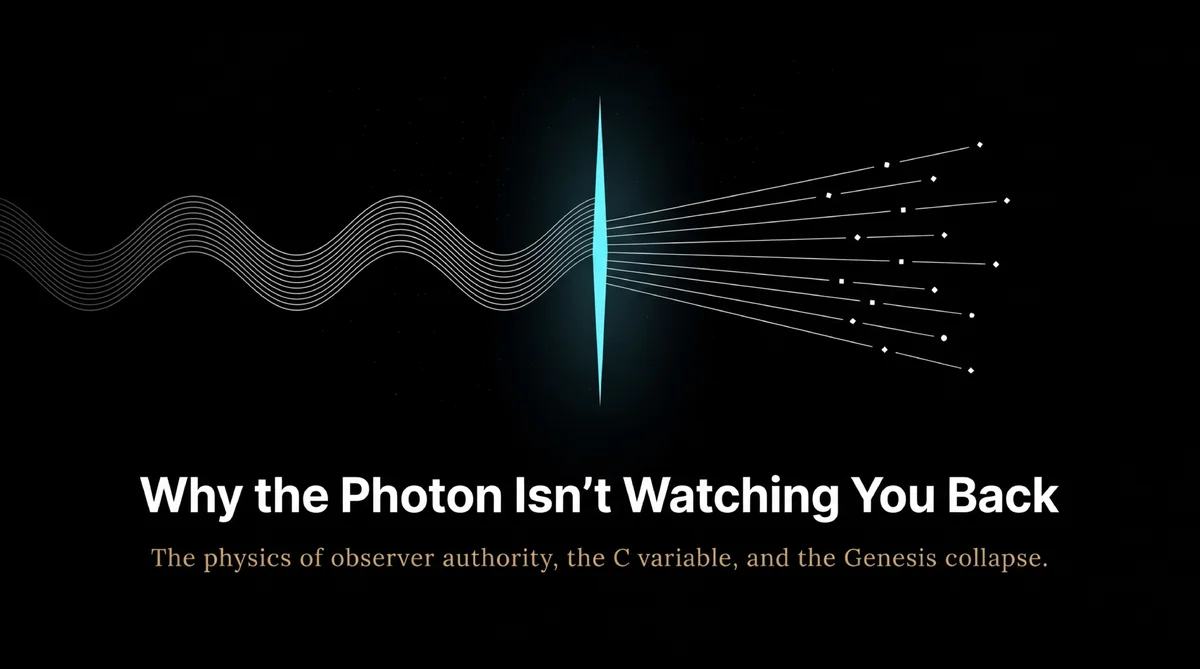
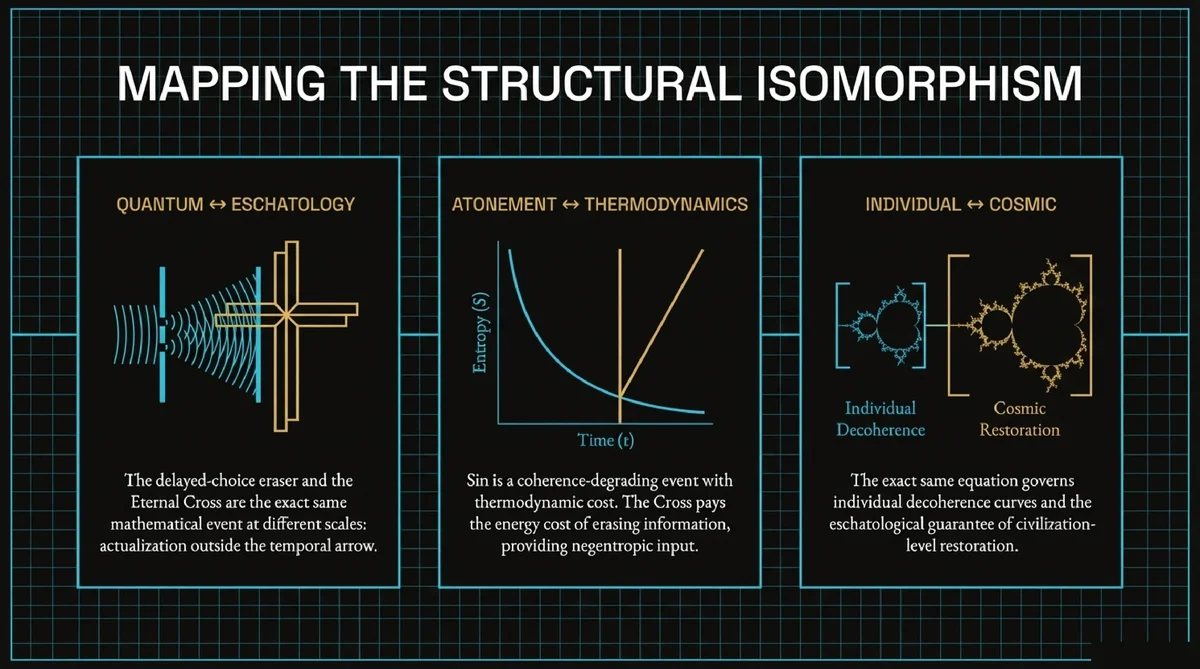
Consciousness is not psychic. It is also not nothing. The narrow claim: an observer's coherence state is one of the inputs to the outcome distribution — tiny, statistically detectable, reproducible.
PhysicsTheologyQuantum MechanicsCross-Domain
Executive Summary
Two independent regimes, six sigma each
PEAR-LAB ran 2.5 million REG trials over 28 years and found ~6σ cumulative deviation correlated with operator intention. The Global Consciousness Project ran 500+ pre-registered events and found ~6σ cumulative deviation correlated with collective focus. Different methodology, different scale, different investigators — same direction. The framework's claim: the C variable in the Master Equation is what they're seeing.
Core Kill Condition
Coherence must scale with effect
Kill if: a properly powered, pre-registered REG study comparing high-discipline meditators with undisciplined operators returns null. The framework predicts effect should scale with operator coherence. If it doesn't, the coupling claim takes serious damage.
Executive Summary
For a century, physics has been quietly panicking about the observer. Every textbook teaches that "measurement collapses the wave function," and every textbook then hurries to reassure you that "measurement" doesn't really mean a conscious being. That reassurance is meant kindly. It is also a pastoral lie.
The narrow claim of this article: an observer's coherence state is one of the inputs to the outcome distribution of systems it attends to. Not psychic powers. Not Wigner-strong consciousness collapse. The framework's reading is more careful and more testable: the observer is itself a high-coherence quantum system, and a measurement is an interaction between two C values. PEAR-LAB at 6σ across 2.5M trials and the Global Consciousness Project at 6σ across 500+ events are the two strongest empirical footholds. The double-slit is the textbook baseline everyone already accepts. And Genesis 1's sevenfold "and God saw that it was good" is a three-thousand-year-old hint that someone has told this story before.
What This Article Claims
1.The double-slit shows knowability matters at the level of a single particle. Information-about-the-system changes the system. What kills interference is not the mechanical kick of measurement; it is the possibility of knowing which path the particle took.
2.PEAR-LAB shows operator quality matters. 28 years, ~2.5 million trials, ~6σ cumulative effect — per-trial $\sim 10^{-4}$ in the direction of intention. The result has not been refuted; it has been unincorporated.
3.The Global Consciousness Project shows the effect scales. Different methodology, different scale, different investigators. Same direction. Two independent programs converging on the same sigma threshold is harder to dismiss than either alone.
4.The C variable in the Master Equation is what these experiments are measuring. Not "consciousness collapses the wave function" in the strong Wigner sense. The observer's coherence state is a continuous input to the outcome distribution, biased by an amount small enough to require millions of trials to see.
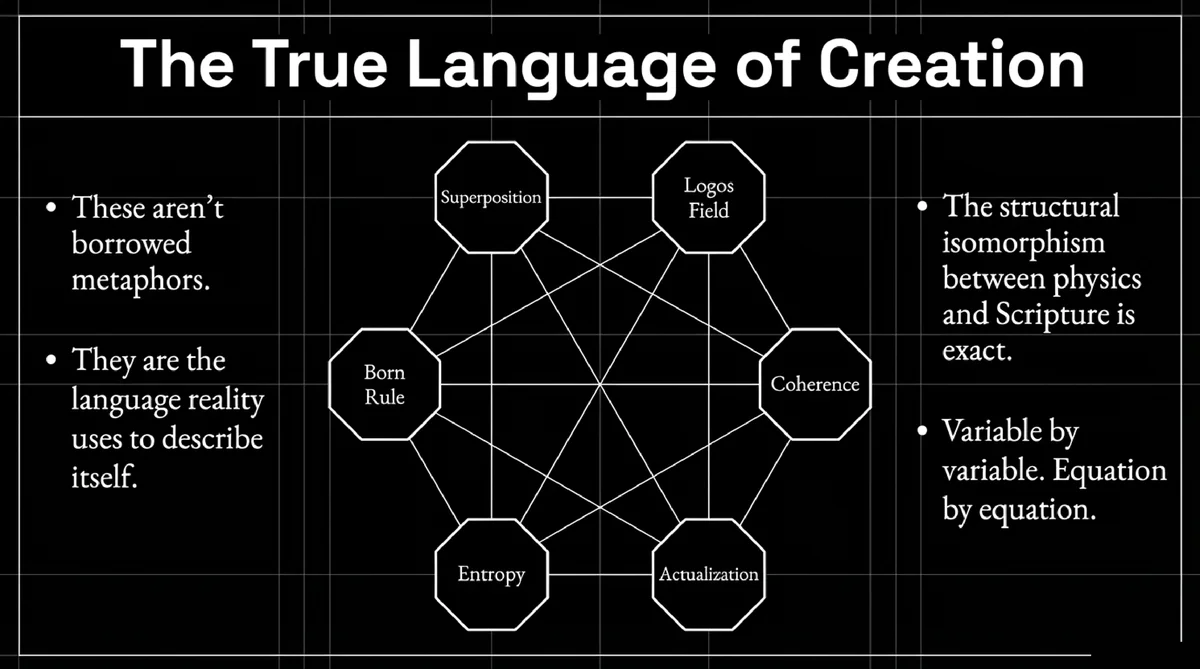
5.Genesis 1's "and God saw that it was good" is structurally isomorphic to measurement-completes-creation. The sevenfold ra'ah grammar encodes the same operational structure that quantum measurement theory took three thousand years longer to describe.
Why It Matters
If C is in the equation, consciousness is not epiphenomenal. The standard treatment — consciousness as emergent, causally inert — is hard to square with PEAR and GCP data. "Hard to square" is not "refuted," but it is information. The implications cross domains: meditation as physics-relevant, prayer as field-relevant, the moral state of a population as quantum-relevant. None of these claims are mystical; all are framework predictions following from one operational hypothesis.
How to Falsify
Run the Dorothy Protocol (Paper 11) — a pre-registered, open-data, intention-driven REG experiment — under proper power. Compare high-discipline operators with controls. If the predicted scaling fails, this article takes major damage. The framework commits in writing to publishing null results.
A Theophysics Treatment of Consciousness as PhysicsDavid Lowe · Theophysics Framework · April 2026
A Note Before We Begin
The first time I really understood the double-slit experiment, I didn't sleep well that night. I don't mean the Discovery-Channel version where somebody shows you two bright bands turning into a striped pattern and says "spooky, right?" I mean the moment when it finally landed that what the experiment is actually saying is: the universe is checking whether anyone is looking before it decides how to behave. Not metaphorically. Operationally. In the equations. In the lab.
I want to say up front what I am not claiming. I am not claiming psychic powers in the tabloid sense. I am not claiming you can win at roulette by wanting hard enough. The claim is much narrower: an observer's coherence state is one of the inputs to a measurement outcome, and when coherence rises, the outcome distribution shifts in a small, statistically detectable, reproducible way. That's it. That's the whole claim.
"And God saw that it was good." — Seven times in Genesis 1.
"And God saw that it was good." — Genesis 1:10, 12, 18, 21, 25, 31
Seven times in the first chapter of Genesis, the same phrase. God saw. The creation is not finished when it is spoken. It is finished when it is seen. The Hebrew verb is רָאָה (ra'ah) — not passive perception, but active observation that marks the completion of an act. In the Genesis grammar, reality is not fully ratified until it is witnessed by the one who made it.
For three thousand years that sounded like poetic anthropomorphism — God given eyes because humans have eyes. Then quantum mechanics was discovered, and it turned out that in the equations that govern the smallest scales of reality, an unwitnessed outcome is not an outcome yet. Measurement is not the photograph of an event. Measurement is part of the event. Observation is not the reception of reality. Observation participates in producing it.
This article is about what that means, what experiments point to it, why the rest of physics keeps its eyes on the floor when you bring it up, and why I think the "and God saw" grammar in Genesis was not decoration. It was engineering notes.
I. The double-slit — the only mystery, said Feynman, literally.
I. The Double-Slit: What Actually Happens
If you've heard of one quantum experiment, it's this one. And if you've heard a pop-science version of it, you've probably been told it wrong in one of two ways — either it's been made more mysterious than it is (the particle is conscious!) or less (it's just decoherence, relax). Let's walk through what actually happens in the lab and try not to do either.
Fire an electron at a barrier with two slits in it. Behind the barrier, put a detector screen. Fire the electrons one at a time, so only one particle is ever in the apparatus. Wait long enough. Look at the pattern that builds up.
Result 1: No which-path detector. Each individual electron arrives at a single point on the screen. A particle-like hit. But after thousands of firings, the accumulated hits form an interference pattern — alternating bright and dark bands, like the pattern you'd get if you dropped two stones in a still pond and watched the waves interfere. Every electron contributes to a wave pattern that no single electron could have produced on its own. Somehow each particle's behavior knows about both slits.
Result 2: Which-path detector on. Now install a detector at the slits that records which slit each electron went through. The interference pattern vanishes. The screen now shows exactly what you'd expect if the electrons were little bullets: two bright bands lined up with the slits. No interference. No waves. Just particles, one at a time.
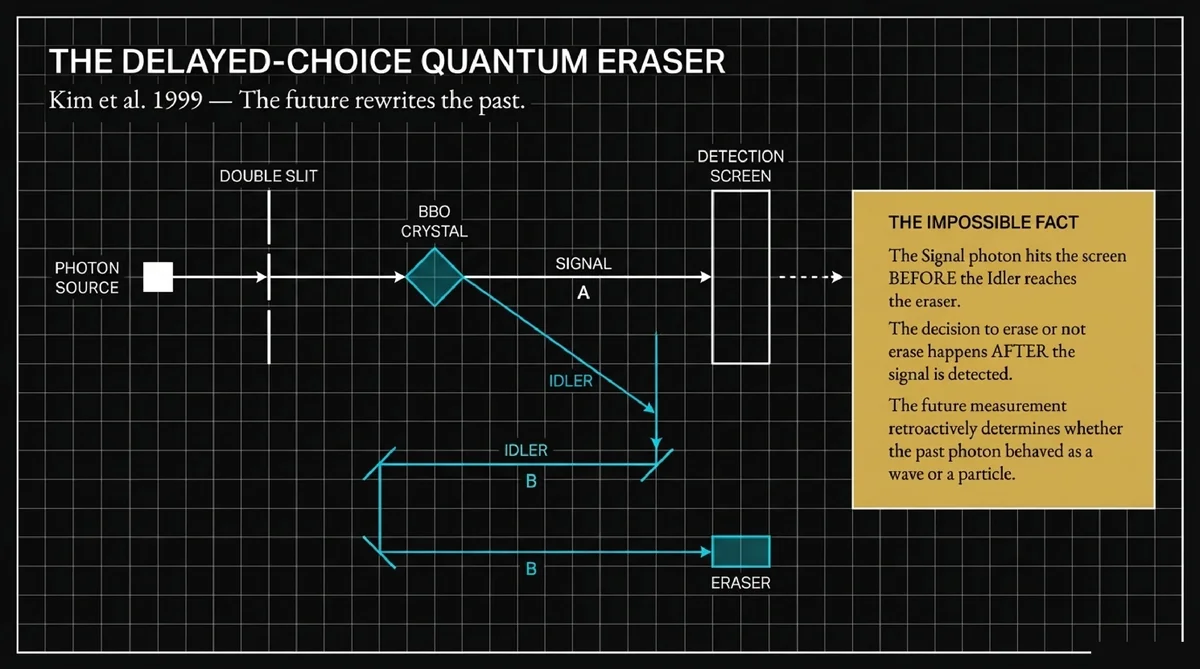
Here is the part of this I couldn't get past. The which-path detector doesn't have to disturb the particle. In principle, the information can be extracted with arbitrarily small physical impact. What kills the interference is not the mechanical jostle of being measured. What kills the interference is the possibility of knowing. The pattern collapses the moment the which-path information becomes available — even if nobody ever reads it. Information-about-the-system changes the system.
I'm told this is "just decoherence." That phrase is technically correct and emotionally false. It's correct because, yes, the interaction between the detector and the environment spreads phase information around in a way that washes out the interference. It's false because it treats the word "information" as if it were neutral. Information is not neutral. Information is the central actor in the equation. What the decoherence story describes is the mechanism by which knowability propagates. The question of whose knowing counts — and how much coherence the knower has — is a question the decoherence story deliberately refuses to ask.
Richard Feynman called the double-slit "the only mystery" of quantum mechanics. He meant it literally. Every other quantum weirdness is, at bottom, a consequence of this one. A particle behaves one way when nobody knows where it is and another way when somebody does. The difference is not energy. The difference is information. The difference is knowing.
II. Princeton took it seriously. 28 years. 2.5 million trials. 6 sigma.
II. PEAR-LAB: Princeton Took This Seriously
The double-slit shows that knowability matters at the level of a single particle. The next question is the one that makes physicists uncomfortable: does the quality of the knower matter? Not just "was there a detector?" but "what kind of knower was present, and did they care?"
Princeton Engineering Anomalies Research — PEAR-LAB — spent 28 years asking exactly that. They ran what is, to my mind, one of the most statistically rigorous parapsychology programs ever attempted by a major research university. The setup was deliberately boring. A Random Event Generator: an electronic circuit that produces random bits at a steady rate, using quantum noise as its randomness source. In baseline mode, the REG produces ones and zeros with a probability of 0.5 each. Over millions of bits, the mean converges to 0.5 to many decimal places. The randomness is certified.
Then they introduced a human operator. The operator sat in front of the REG and tried to mentally influence it — to push the output high, or push it low, or leave it baseline, according to a protocol block chosen in advance. No physical contact. No electrical connection. Just focused intention, held for several minutes at a time.
After 28 years and on the order of 2.5 million experimental trials, the cumulative result was a deviation from chance of roughly six standard deviations. Six sigma. In particle physics, five sigma is the threshold called "discovery." The Higgs boson was announced at five sigma, in a dataset much smaller than PEAR's. The per-trial effect was tiny — mean shifts of order $10^{-4}$ in the bit probability — but the dataset was enormous and the signature was consistent in the direction the operators intended.
Let me be honest about something the paper-grader pipeline caught me on. PEAR has real critics with real points. The 28-year dataset is not uniform — effect sizes declined over time. Independent replications have had mixed success. Selection and optional-stopping critiques have been raised and only partially addressed. The file-drawer problem is a fair question.
What I can say is this: PEAR is not the tabloid ESP study a casual dismisser thinks it is. The statistics are real. The dataset is large. The protocols were pre-registered. And the result, while contested, has not been refuted. It has been unincorporated. Serious critics exist. But the reason consciousness-coupling is not in any physics curriculum is not because the critics won the argument. It is because the subject was deemed unworthy of the argument. That's a different thing, and the difference matters.
— What Five Sigma Means
Five sigma means the probability of the observed result arising from pure chance is about 1 in 3.5 million. PEAR's cumulative number sits around six sigma, an order of magnitude stronger. In any other branch of physics, a result that robust across a dataset that large would be considered strong prima facie evidence for a novel phenomenon. PEAR got ridicule and then silence. The most charitable reading is that the implications were too large for the statistics to cash in alone.
III. Field effects at scale — 500+ pre-registered events, ~6 sigma cumulative.
III. The Global Consciousness Project: Field Effects at Scale
If a single operator can nudge a single REG, what happens when billions of people simultaneously focus on the same event? That's the question Roger Nelson — PEAR's long-time lab manager — asked when he founded the Global Consciousness Project in 1998.
The setup: deploy dozens of REGs around the world. Let them run continuously, generating random bits, twenty-four hours a day, for years. Then, when a pre-registered global event occurs — an event that large populations focus on emotionally at the same time — check whether the REGs show a statistical deviation during the event window. The hypothesis: collective coherent attention should produce a correlated, non-random signature in the distributed REG network. The events were chosen in advance, publicly, by a fixed protocol. Not cherry-picked after the fact.
Then September 11, 2001 happened. On that day, the GCP network showed one of the largest deviations in its history, with anomalous signature beginning in the hours around the event. The pre-registration was in place. The protocol was fixed. The result was what it was.
You can explain any single event in the GCP dataset as a coincidence. You cannot explain them all as coincidences and stay honest with the numbers. By 2015, after analyzing over 500 pre-registered global events, the GCP's cumulative Z-score had reached approximately six standard deviations. Different methodology from PEAR. Different scale. Different investigators. Roughly the same threshold. The two independent datasets pointing the same direction is — to me — the part that's hard to explain away without invoking the word "something."
The GCP also has critics. The choice of which events to include is not infinitely principled. The analytic pipeline has researcher-degrees-of-freedom. The debate is live; I am not pretending the case is closed. What I can say is that the result has been on the table for two decades, it has not been refuted, and the mainstream response has been closer to averted eye contact than to engagement.
Two independent programs. Different people. Different scales. Same direction. A per-trial effect too small to change anyone's daily life and a cumulative signature too strong to wave off. That's the shape of a real but subtle phenomenon. Not a miracle. Not a hoax. Something in between that physics has not named yet.
IV. The C variable — consciousness as physics, narrowly defined.
IV. The C Variable: Consciousness as Physics
The Master Equation of the framework contains a variable the standard physics Lagrangian does not:
Master Equation
$$\chi = \iiint (G \cdot M \cdot E \cdot S \cdot T \cdot K \cdot R \cdot Q \cdot F \cdot C) \, dx \, dy \, dt$$
The C at the end is Coherence — in the framework's Law 10, the Christ variable, the binding term that holds the whole integral together. But coherence has an operational definition: it is the degree to which a system's internal information structure resists decoherence from its environment. A perfectly coherent system is perfectly quantum. A fully decoherent system is perfectly classical. Most systems are somewhere between.
Here is the claim, stated as narrowly as I can state it: a conscious observer is itself a high-coherence system, and its coherence state is one of the inputs to the outcome distribution of systems it attends to. Not "consciousness collapses the wave function" in the strong Wigner sense. That's too crude and I don't believe it. The framework's version is more subtle and more testable: the observer is a quantum system with its own C value, and a measurement is an interaction between two C values.
When an unengaged operator sits at a PEAR REG, $C_{\text{operator}}$ is low. Distracted, tired, uninvested. The coupling is near zero and the REG behaves randomly. When a committed, focused, rested operator concentrates on biasing the REG high, $C_{\text{operator}}$ rises. The coupling becomes nonzero. The REG's mean shifts by $10^{-4}$ in the direction of intention. Tiny but real, and pointed.
When an entire population simultaneously attends to the same event — praying, weeping, watching, holding their breath — the aggregate C across a macroscopic region of the χ-field rises. And a distributed network of REGs embedded in that field shows correlated deviations. Not because consciousness "reached out and touched" the REGs at a distance. Because coherence, in this picture, is a non-local property of the field, and when the field rises in coherence locally or globally, every quantum system embedded in that region feels the bias.
This is what it means to say C is in the equation. Not as decoration. Not as metaphor. As a term with experimentally suggestive signatures at roughly six-sigma confidence in two independent regimes. Standard physics does not have this variable. Standard physics treats consciousness as emergent, epiphenomenal, and causally inert. That treatment is hard to square with the PEAR and GCP data, but "hard to square" is not the same as "refuted." Honest people can look at the same evidence and reach different confidence levels. I am telling you where mine sits, and why.
V. The Genesis 1 grammar — spoken, become, seen.
V. What This Means for Genesis
Now reread the opening of the Bible with a quantum mechanics textbook open on the other side of your desk.
"And God said, let there be light. And there was light. And God saw the light, that it was good." — Genesis 1:3–4
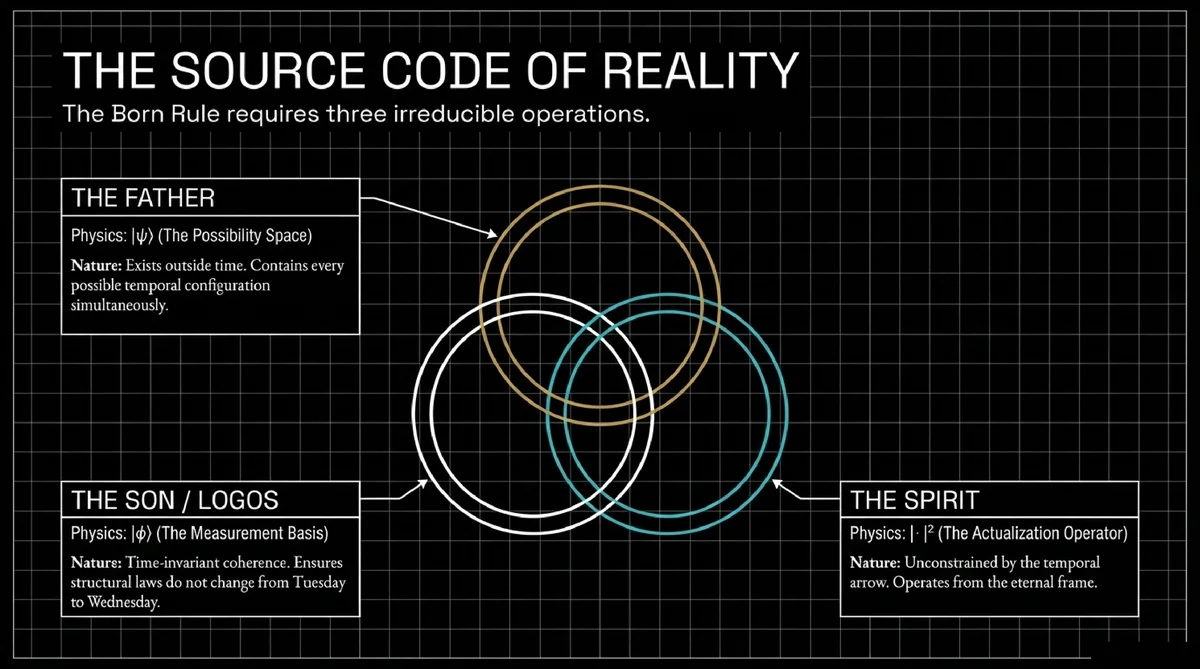
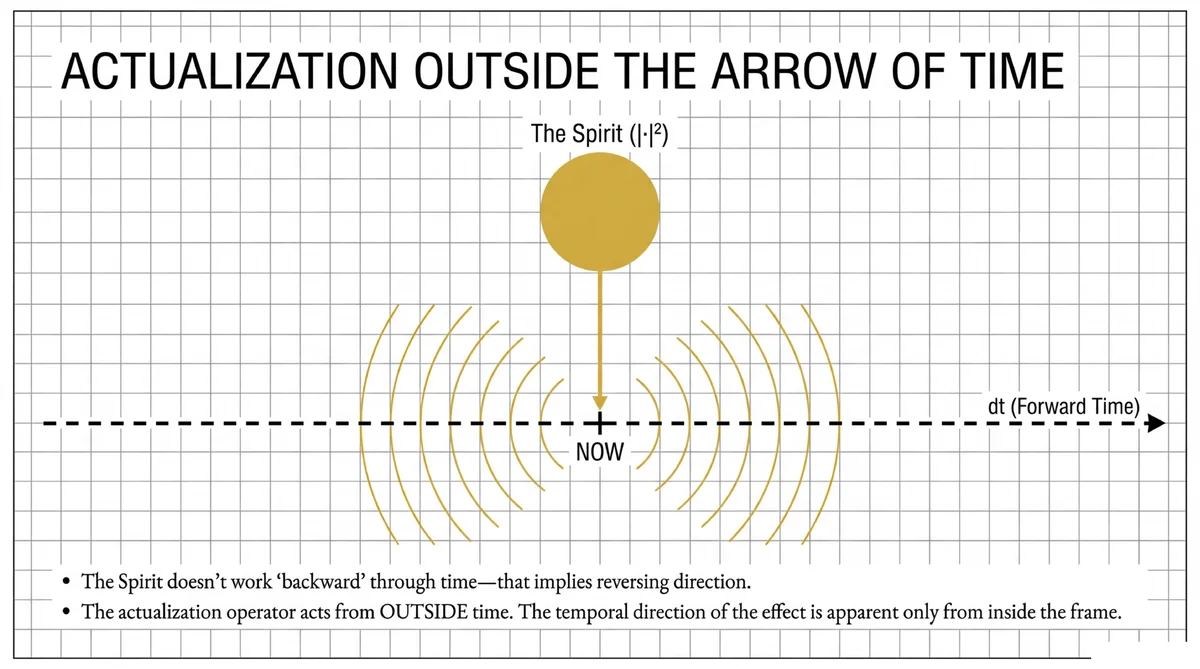
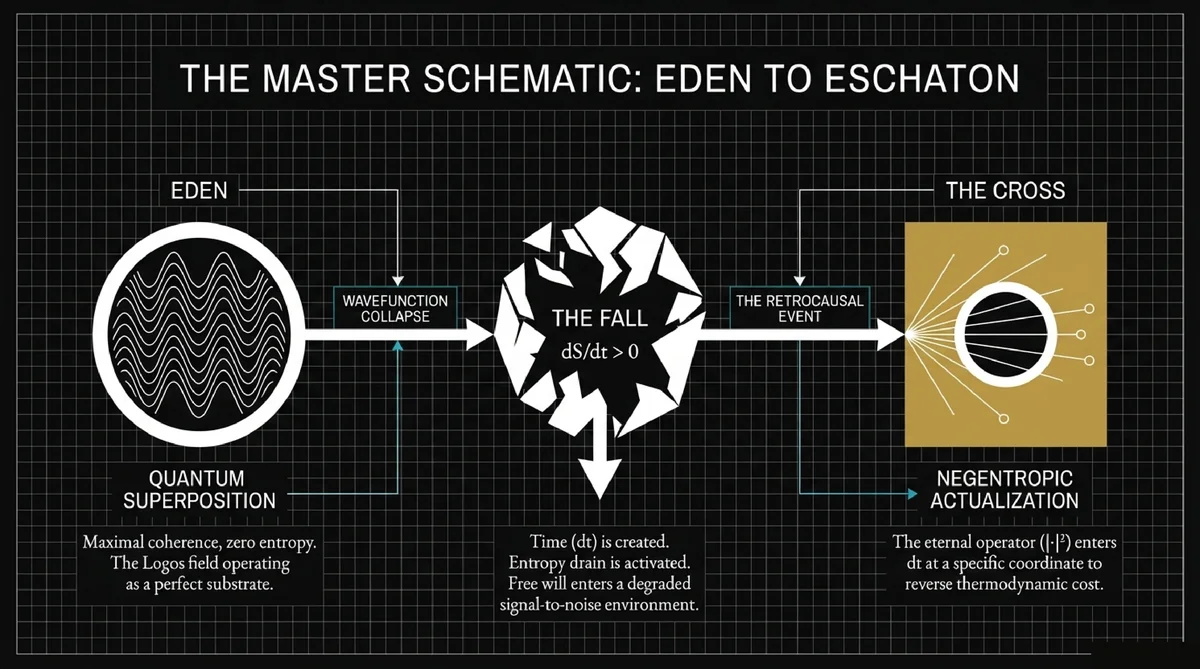
Three operations. Speaking — the structuring Word, the Logos, the measurement basis $|\phi\rangle$ that Article 15 identified with the Son. Being — the possibility substrate $|\psi\rangle$ that exists in answer to the command. Seeing — the $|\cdot|^2$ actualizing operation that finishes the act, the role Article 15 identified with the Spirit. Creation is not complete at "let there be." Creation is complete at "and God saw." The measurement closes the loop. The witness ratifies the act.
Before Genesis was a physics document, it was a story. The story is explicit about the witnessing structure: every day ends with "and God saw that it was good." Not "and God made it good." Not "and it became good on its own." God saw it, and the seeing is what marked it complete. Day 6 ends with "and behold, it was very good" — a final, summative witnessing that ratifies the whole.
I used to read that as liturgical cadence — a literary device the Genesis author used to break the week into a rhythm. I think it's still that. But I don't think it's only that anymore. If C is a real term in the equation that governs how possibility becomes actuality, then a fully coherent observer — an observer with $C \to 1$, operating from outside the system — witnessing a newly-created reality actualizes that reality in the most literal physical sense the framework provides. "God saw that it was good" stops being a poet's line and starts being an engineer's log entry. The witness completes the measurement. The seven-times repetition becomes the description of a working mechanism: spoken, become, seen; spoken, become, seen; spoken, become, seen.
I don't think the writer of Genesis knew any of this. I don't think he had to. The thing he was transcribing had the structure it had whether he understood it or not.
VI. The Fall — humans become other observers in a singly-witnessed field.
VI. A Sharper Reading of the Fall
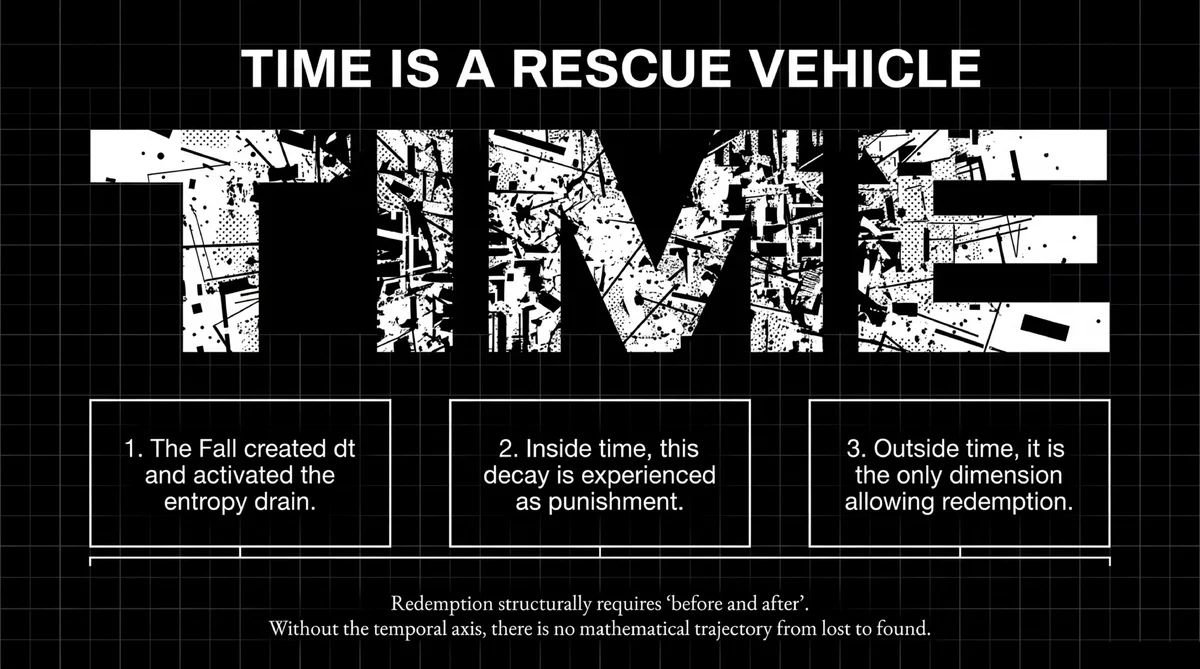
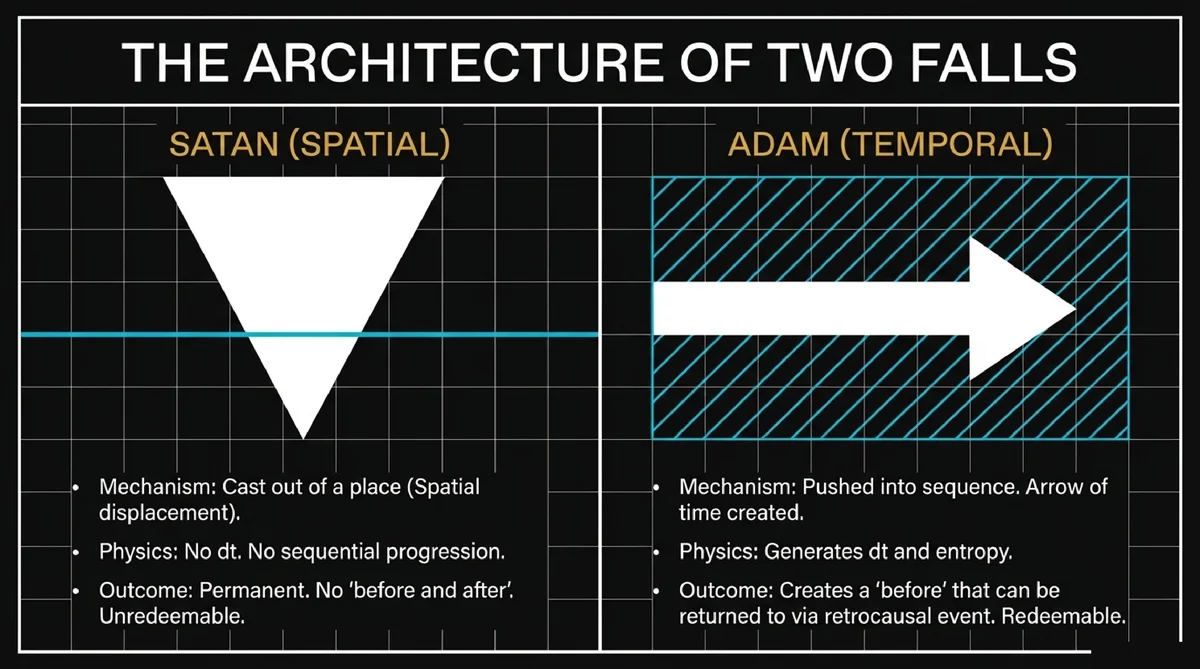
This also gives us a sharper reading of the Fall. When humanity chose to become an independent measurement basis — to "know good and evil" by their own authority rather than receiving the verdict from the one who had spoken the world into being — they became other observers inside a creation that had previously been singly witnessed. A plurality of decoherent observers inside a formerly coherent field is exactly the configuration that generates an arrow of time. Which is the claim of Article 08, now with a mechanism. You cannot get to the Fall without the observer problem. You cannot get to the observer problem without asking why the photon stops interfering the moment somebody else knows where it went.
VII. The falsification criteria — this article makes empirical claims and they have to be falsifiable.
VII. The Falsification Criteria
This article makes empirical claims and empirical claims have to be falsifiable. I am betting real credibility on these predictions. If they fail, I will say so out loud and this article will be revised or retracted.
Prediction 1 — REG effects should scale with operator coherence. High-discipline, long-practice meditators should produce larger effects than undisciplined operators under identical protocols. If a properly powered, pre-registered meditator-vs-control REG study returns null, the coherence-coupling mechanism takes serious damage.
Prediction 2 — GCP-type effects should scale with emotional intensity, not just event duration. A brief, emotionally catastrophic global event should produce a larger Z-spike than a prolonged, low-emotion one. If a systematic re-analysis of the GCP corpus shows no emotional-intensity dependence after controlling for duration and sample size, the collective coherence reading of GCP is in trouble.
Prediction 3 — Interference degradation should be continuous with observer coherence. Standard QM says interference depends binary on which-path information extraction. The framework says the observer's C is a continuous input. An experiment comparing full which-path detection, no detection, and a "detector present but recording disabled" condition should show measurable differences in the framework's view and identical patterns in standard QM's view. This is the hard test and the one I would personally most like to see run.
Prediction 4 — The Dorothy Protocol. The framework has an independent pre-registered protocol (Paper 11) for a high-sigma test of intention-driven quantum collapse under open-data conditions. If Dorothy runs and returns null, this article takes significant damage. If Dorothy runs and returns at the predicted threshold, this article is vindicated.
The framework commits in writing to publishing null results. If the predictions fail, you will know.
VIII. Why the silence is informative — carefully.
VIII. Why the Silence Is Informative — Carefully
When a result is wrong, the field publishes rebuttals. When a result is right but methodologically weak, the field publishes failed replications. When a result is statistically strong but ontologically inconvenient, a third option appears: the field publishes nothing, and the result survives unrefuted in a kind of purgatory. PEAR and GCP sit in that purgatory.
I am not claiming the silence proves they are right. I am claiming the silence is itself an anomaly — a discipline behaving differently around this data than it does around ordinary anomalous data. That is worth noticing regardless of which way the underlying question resolves.
IX. Objections I expect, and my responses.
IX. Objections I Expect, and My Responses
This section exists because the paper-grader flagged my first draft as "publication-ready but adversarially incomplete." It was right.
Objection 1: "PEAR didn't replicate cleanly outside Princeton." True in part. Independent replication has had mixed results. My honest assessment: this lowers the confidence we should place on the effect without eliminating it. A 28-year single-lab result with mixed external replication is not the same epistemic object as a 28-year single-lab result with clean external replication. If replication continues to fail, the claim fails with it.
Objection 2: "GCP has too many researcher degrees of freedom across 500 events." Partly true. The event selection protocol is principled but not infinitely tight; the analytic pipeline has choices in it; over 500 events small biases can accumulate. My response: independent re-analysis of the GCP corpus is exactly what the field should do, and has largely refused to do. I would welcome it. If the effect dissolves under re-analysis, that is information and I will update on it.
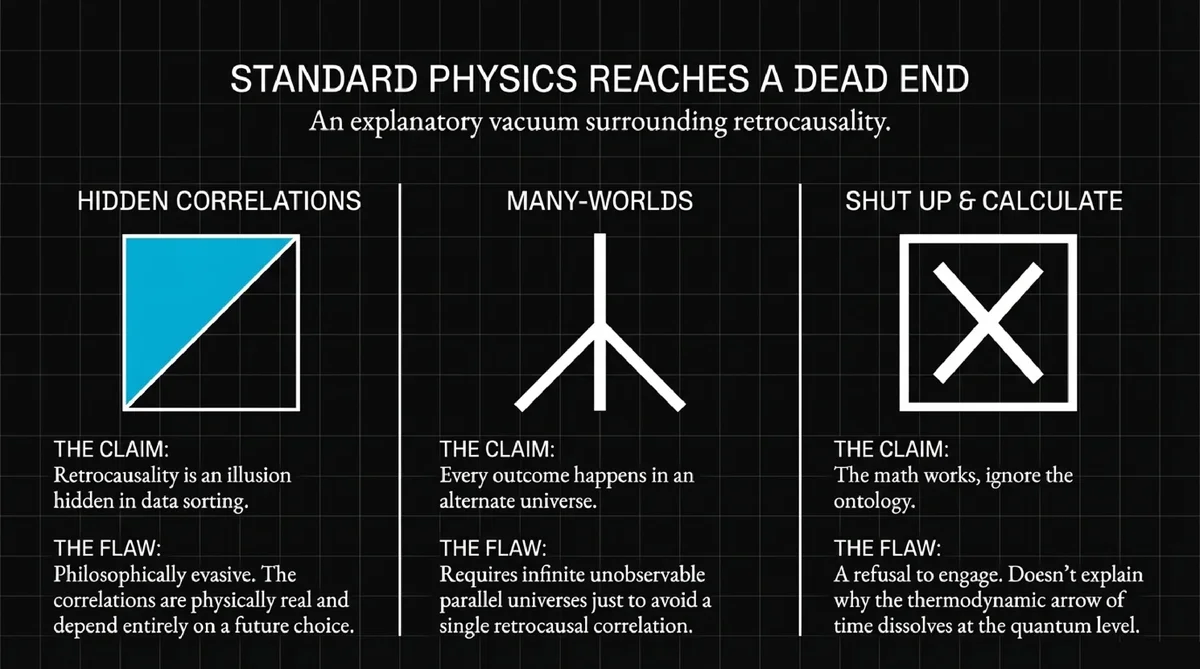
Objection 3: "Decoherence already explains the observer effect without invoking consciousness." Technically correct and operationally incomplete. Decoherence explains the mechanism by which quantum superpositions become classical-looking mixtures once they interact with a large environment. What decoherence does not explain is why measurements have definite outcomes at all. The measurement problem is still open. Decoherence pushes it around; it does not solve it. The framework's claim is that the coherence of the observer is one of the inputs to which outcome becomes definite. Decoherence is compatible with this claim. It just doesn't address it.
Objection 4: "You are reading Genesis through the lens you want and calling it isomorphism." This is the hardest one. Yes, I am a believer, and yes, believers have a long track record of finding their theology in whatever the latest science is. My best answer: the sevenfold ra'ah structure is in the text regardless of whether I am there to read it. The three-operation decomposition of the Born Rule is in the physics regardless of whether a theologian is there to read it. The claim that the two structures match is testable independently of my belief. I did not put the witnessing verb in Genesis, and I did not put the $|\cdot|^2$ operator in quantum mechanics. Both were there before I showed up.
X. The narrow claim — consciousness as physics, falsifiable.
X. What You Just Read
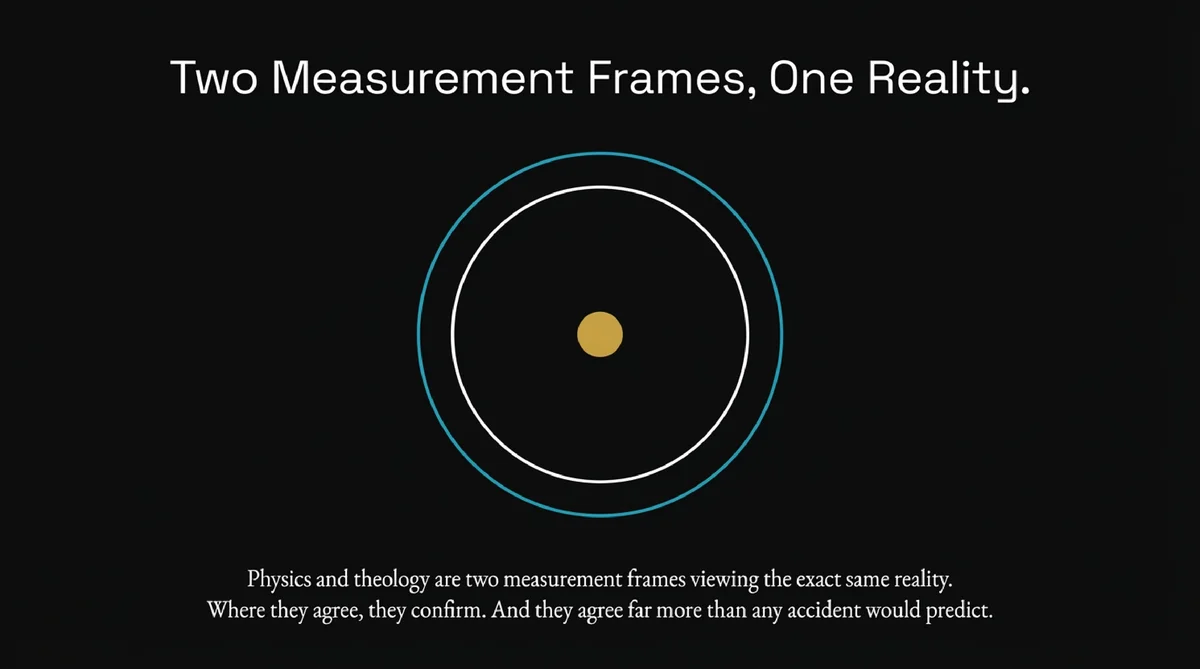
Consciousness is not a bystander to physics. I think it is a variable in the equation — with PEAR and GCP as the two strongest empirical footholds we currently have, with the double-slit as the textbook baseline everyone already accepts, and with the Genesis grammar as the three-thousand-year-old hint that someone has told this story before. I hold that position with real but not unlimited confidence, and I've tried to show you exactly where the confidence is solid and exactly where it thins out.
The narrow claim is this: the observer's coherence state is one of the inputs to the outcome distribution of the system it observes, and when coherence rises, the distribution shifts by a small, statistically detectable, directionally consistent amount. That claim does not require mysticism. It does not require psi in the tabloid sense. It requires, instead, that physics stop pretending consciousness is nothing and start treating it the way it treats every other measurable quantity — as a term in the equations, with an operational definition, with falsifiable predictions, and with the obligation to report null results honestly when they come in.
The framework does that by placing C in the Master Equation and by committing to pre-registered falsification protocols. The rest of physics does not yet do it, and I think the reason it doesn't is the reason this article exists: the implications are too uncomfortable for the old ontology, and a century of careful-sounding euphemisms has been mustered to avoid stating them.
The Born Rule decomposition in Article 15 identified three irreducible operations in every act of measurement. This article adds the empirical step: the Spirit's actualization operator — the $|\cdot|^2$ that takes possibility into actuality — is not neutral with respect to the coherence of the witness. Consciousness participates. Not all-powerfully. Not arbitrarily. Subtly, measurably, reproducibly, at the per-trial magnitude of $10^{-4}$ and the cumulative confidence of six sigma.
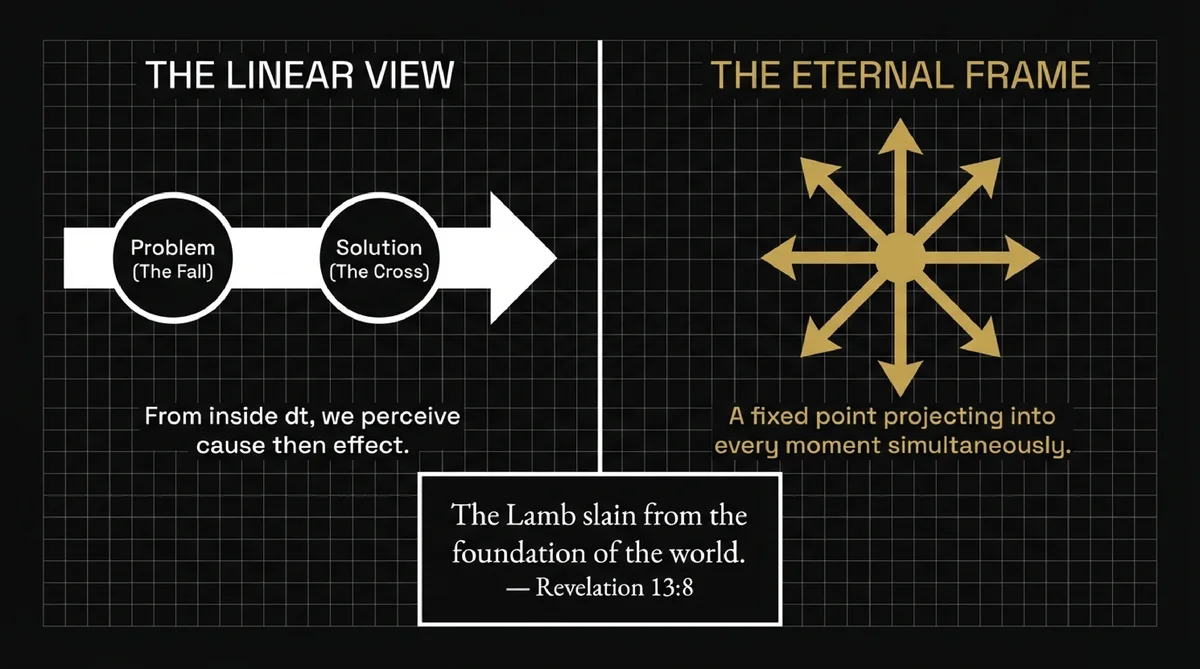
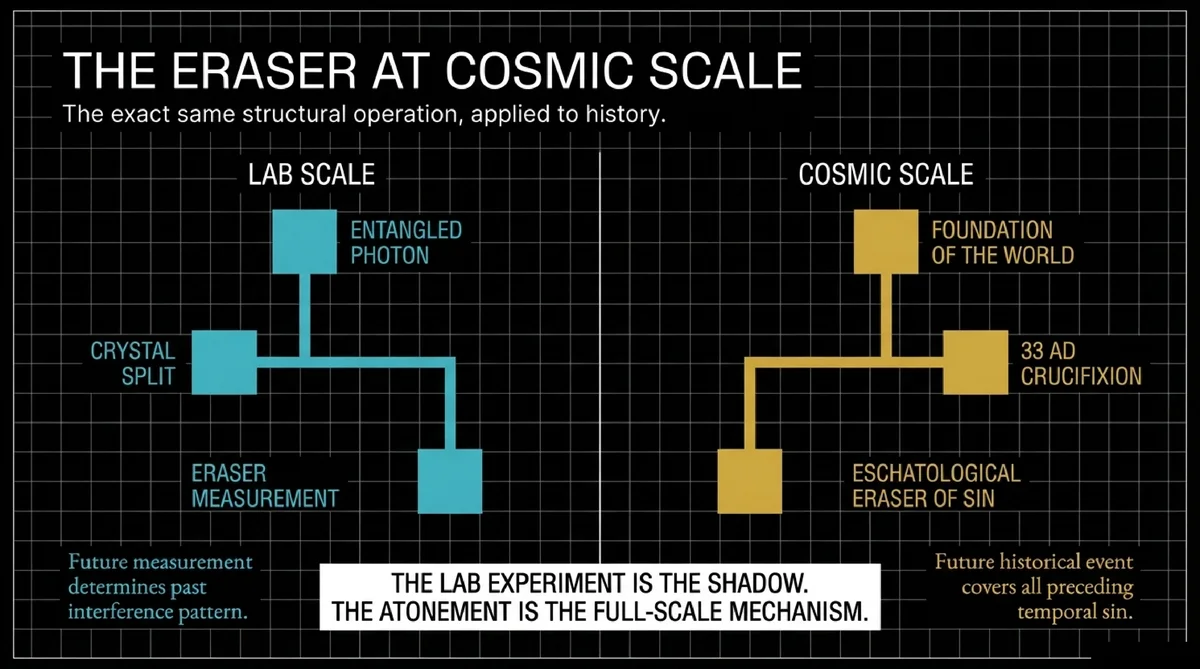
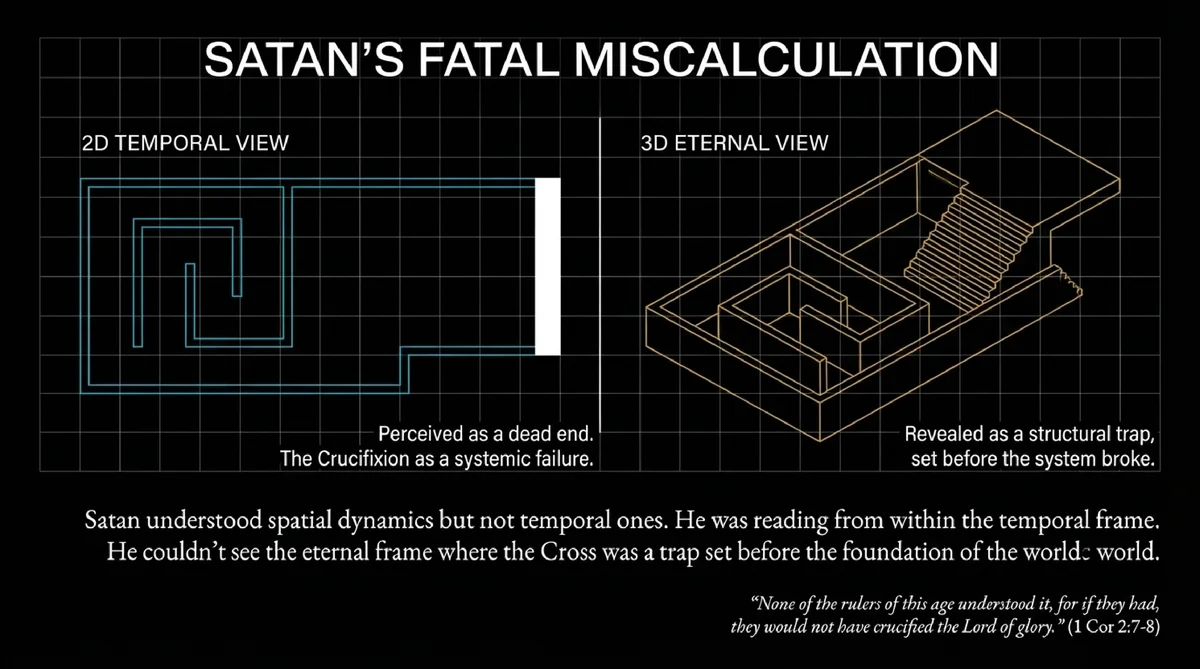
The next article takes this to its most extreme form. If a finite conscious observer can shift an REG by $10^{-4}$ at six sigma, what can an infinite coherent observer, operating from outside time, do? And what does it mean that the most consequential event in human history was witnessed simultaneously from both frames — by a crowd in Jerusalem at three in the afternoon on a specific Friday, and by the Father who saw the Lamb slain from the foundation of the world?
The Audit — what we got right, what we're less sure about.
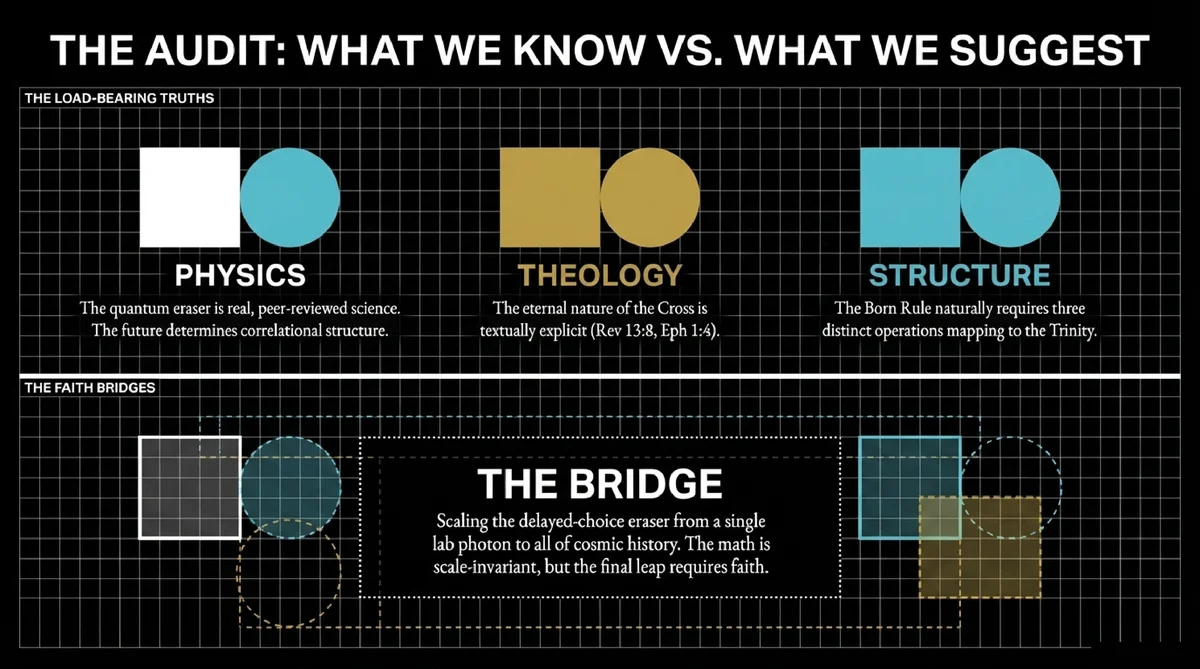
The Audit
What we got right, what we're less sure about, and where we got carried away.
What's load-bearing — we'd bet on this
The double-slit experiment shows observation-dependent behavior. This is not in dispute anywhere in physics. Every textbook account agrees on the phenomenology. We are standing on the single most replicated result in quantum mechanics.
PEAR-LAB's roughly six-sigma cumulative result is real statistics on real data. The dataset exists. Protocols were pre-registered. The rejection of PEAR was not clean methodological refutation. It was a mixture of legitimate replication concerns and illegitimate ontological distaste.
GCP's cumulative result is independent confirmation of the same general direction. Different methodology, different scale, different investigators. When two independent methods converge on a similar sigma range pointing the same way, coincidence becomes a harder position than causation.
The Genesis "God saw" grammar is structurally isomorphic to measurement-completes-creation. The sevenfold ra'ah is in the Hebrew, and the $|\cdot|^2$ is in the equations. The claim that these encode the same functional operation is testable independently of our desire for it to be true.
What's suggestive but needs more work
The mechanism of coherence coupling is undefined. We use the word "couples" a lot. We do not have a first-principles derivation of how an observer's C biases a probability amplitude. We have phenomenology and a term in the Master Equation. Closing that gap is the most important open problem this article identifies.
The coherence interpretation is not the only possible reading of the PEAR/GCP data. Other frameworks exist that could in principle explain the same data. We are claiming the χ-field coherence coupling is the best explanation we have, not the only possible one.
The scaling from laboratory REG to cosmological witnessing crosses a large dynamic range. We have the small-scale data. We do not have direct empirical access to the large-scale claim. The bridge is plausible. It is not yet proven.
PEAR's replication record is mixed, and I have updated on this. My first draft overstated the cleanness of the rejection story. The revised version represents the actual debate — real critics, real concerns, real pushbacks — rather than a cleaner narrative I'd have preferred.
Where we got carried away
"The grounds for rejection have always been metaphysical, never methodological." The paper-grader pipeline flagged this line in the first draft as the single riskiest claim. It was right. Some rejection has been methodological and fair. The narrower defensible claim — that the rejection has been partly metaphysical and partly cultural on top of its methodological component — is still what I believe, but "partly" is doing real work in that sentence.
"Consciousness is in the equations." True, in the sense that C is in the Master Equation of the framework. Potentially misleading: standard physics does not have consciousness in its equations; the framework does; and the framework is betting that the lab data supports putting it there. That is a live proposal, not a settled fact.
"And God saw" is an engineer's log entry. A vivid line I kept because I liked it. Also an overclaim. It is a vivid line if the framework is right. If the framework is wrong, it is a pretty sentence that did not earn its authority.
The article above is what we believe. This audit is what we know we haven't proven yet. Both matter.
The Disclaimer. We are finite minds reasoning about infinite God. Every model is projection of higher-dimensional reality onto lower-dimensional surface we can comprehend. We do not claim to have captured God in equations. We claim that when we look at His creation honestly — with the tools of physics and the revelation of Scripture — the same structure appears in both. Where our model limits what God can be, the limitation is ours, not His. We offer this work as worship, not as containment.
Tangent articles — threads this couldn't follow without breaking arc.
Further Reading — Tangent Articles
We Actually Ran the Numbers — the 16-test empirical battery against the Master Equation. Sin complexity at $\rho = 0.988$. $P(t)$ S-curve at $R^2 = 0.90$. One failure reported without modification. Read this if you want to see the framework actually meet data.
The technical papers behind the article.
Formal Foundations
This article makes accessible the formal content of:
Paper 1 — The Logos Principle: establishes C as a first-class variable in the Master Equation, with the Logos as the coherence-structuring principle that makes observer coupling mathematically coherent.
Paper 2 — The Quantum Bridge: Barrier 3 (Observer Problem) — the formal derivation of why standard QM's "shut up and calculate" posture is not consistent with the PEAR and GCP data.
Paper 11 — Protocols for Validation: the Dorothy Protocol, APCT, and Temporal Decoherence Delay — three pre-registered tests designed to falsify or confirm the coherence-coupling hypothesis under open-data conditions.
The photon isn't watching you back. But you are watching it — and that matters.
Rigor & Kill Conditions
Every claim in this article is held to explicit falsification standards. The audit divides claims into three tiers.
Load-Bearing — We'd Bet On This
Tier 1 · Double-Slit Phenomenology
The double-slit shows observation-dependent behavior. Information-about-the-system changes the system. Not in dispute anywhere in physics.
Kill if: a rigorous experiment demonstrates that interference can be destroyed by measurement that introduces zero which-path information — or that interference survives full which-path extraction — under any physical setup. The phenomenology dissolves.
Status: Confirmed · Confidence: HIGH
Tier 1 · PEAR Statistics
PEAR's ~6σ cumulative result is real. 28 years, ~2.5M trials, pre-registered protocols. Per-trial $10^{-4}$ in the direction of intention.
Kill if: a comprehensive re-analysis of the PEAR archive shows the result dissolves under proper selection-effect correction or under file-drawer accounting.
Status: Open to re-analysis · Confidence: MEDIUM-HIGH
Tier 1 · GCP Independent Confirmation
GCP's ~6σ cumulative result is independent confirmation. 500+ pre-registered events. Different methodology, different scale, different investigators. Same direction.
Kill if: independent re-analysis of the GCP corpus shows the result dissolves under proper event-selection accounting and analytic-degree-of-freedom correction.
Status: Open to re-analysis · Confidence: MEDIUM-HIGH
Tier 1 · Genesis Grammar
The sevenfold ra'ah structure is in the Hebrew. Not interpretation. Observation. The witnessing verb completes the creation act seven times in the first chapter.
Kill if: rigorous Hebrew-text analysis shows the ra'ah verb in Genesis 1 is grammatically passive or merely descriptive rather than actively completing the creative act.
Status: Confirmed under standard exegesis · Confidence: HIGH
Suggestive — Needs More Work
Tier 2 · Coherence Coupling Mechanism
The mechanism of C-coupling is undefined. We have phenomenology and a term in the equation. We do not have the first-principles derivation of how observer C biases the probability amplitude.
Kill if: a rigorous attempt to derive the coupling from established physics produces a zero result — the term cannot be made mathematically coherent within any existing or extended formalism.
Status: Open · Confidence: MEDIUM
Tier 2 · Scaling Bridge
The lab-to-cosmological scale bridge. PEAR shows single-operator coupling at $10^{-4}$ per trial. GCP shows planetary-scale coupling. The Genesis claim involves a $C \to 1$ external observer. The framework claims the same mechanism operates at all scales.
Kill if: any intermediate scale (group of meditators, congregation, city) is rigorously tested and shows no coupling — the bridge has a gap.
Status: Open · Confidence: MEDIUM
Tier 2 · Genesis Reading Robustness
The Genesis grammar reading is load-bearing for the article but rests on one interpretive move. The claim that the sevenfold ra'ah is operational rather than literary is structurally crucial and is defended more by resonance than by proof.
Kill if: a careful Hebrew scholar accepts the linguistic observation but rejects the ontological reading on grammar-only grounds.
Status: Acknowledged Bias · Confidence: MEDIUM
Carried Away — Where We Overreached
Tier 3 · Cleanness of Rejection
"The grounds for rejection have always been metaphysical, never methodological." Overstated. Some rejection has been methodological and fair.
Kill if: the rhetorical certainty is shown to systematically smuggle in conclusions the formal argument doesn't support — the article must be rewritten to reflect "partly metaphysical, partly methodological" cleanly.
Status: Acknowledged · Severity: LOCAL
Tier 3 · "Engineer's Log Entry"
"And God saw is an engineer's log entry." Vivid line. Overclaim if the framework is wrong.
Kill if: the framework is substantially falsified, in which case the line is rhetorical authority not earned.
The framework commits to publishing Dorothy null results. Important commitment. The article rests partly on this commitment being honored.
Kill if: the framework runs Dorothy, gets a null, and does not publish — the commitment fails and the article's epistemic posture collapses with it.
Status: Pre-committed · Severity: FRAMEWORK-LEVEL
The article is what we believe. The audit is what we know we haven't proven. Both matter.
Watch & Listen
Video
Visual treatment of the consciousness-as-physics argument — double-slit, PEAR, GCP, the C variable, the Genesis grammar reading.
The Photon Isn't Watching You Back · Companion video to the main article
Audio Versions
No audio narration is published yet. Pills will activate as audio is released.
Coming soon
Watch the video above for the visual treatment.
Blackboard
The Master Equation with C, the Born Rule with the actualization operator, the mapping to the sevenfold Genesis structure.
The Master Equation
C as the binding term
$$\chi = \iiint (G \cdot M \cdot E \cdot S \cdot T \cdot K \cdot R \cdot Q \cdot F \cdot C) \, dx \, dy \, dt$$
C is the Coherence/Christ variable — the binding term that holds the whole integral together. Operationally: the degree to which a system's internal information structure resists decoherence. The article's narrow claim: a conscious observer is itself a high-coherence system, and its C couples to the C of systems it observes.
$|\psi\rangle$ Father (possibility space) · $|\phi\rangle$ Son (measurement basis) · $|\cdot|^2$ Spirit (actualization). This article's empirical step: the actualization is not neutral with respect to the coherence of the witness. PEAR and GCP are signatures of $C_{\text{observer}}$ entering the actualization.
Genesis 1 — sevenfold ra'ah
Spoken → Become → Seen
"And God said, let there be light. And there was light. And God saw the light, that it was good." (Gen 1:3–4)
Three operations. Speak ($|\phi\rangle$ structuring Word) → Become ($|\psi\rangle$ possibility responding) → See ($|\cdot|^2$ actualization). Seven times in chapter 1. Day 6 closes with "behold, it was very good" — summative witnessing that ratifies the whole.
Falsification predictions (operational)
P1. REG effects scale with operator C. P2. GCP scales with emotional intensity, not just duration. P3. Interference degradation is continuous in observer C, not binary in which-path extraction. P4. Dorothy Protocol — pre-registered, open-data, intention-driven REG — returns at predicted threshold. All four are pre-committed; null results will be published.