domains:
- physics
- theology
- information-theory
status: revision-2
tags:
- blackhole
- information-conservation
- Jacob-Bekenstein
- resolution-limit
tier: ontological
title: "Chapter 1: The Universe Is a Language"
type: logos-story
uuid: c1234567-1234-5678-9012-123456789012
series: Logos Story v3
chapter: 1
witness: Jacob Bekenstein
# Chapter 1: The Universe Is a Language
The Witness: Jacob Bekenstein
The fluorescent lights in the Princeton physics library hummed at sixty hertz — a frequency most people stopped hearing after a few minutes, but that Bekenstein could never quite tune out. It was 1972. The building smelled like chalk dust and old carpet and the particular staleness that accumulates in rooms where people think harder than they move. He sat at a table near the back, surrounded by yellow legal pads covered in equations he kept crossing out.
Jacob Bekenstein was twenty-five years old, Israeli-born, quiet in the way that people who are always running calculations in their head tend to be quiet. He had the kind of face that aged well because it started serious. His advisor was John Wheeler — the same Wheeler who had coined the phrase "black hole," who had trained Feynman, who walked the halls of Fine Hall like a man who knew where the edge of knowledge was and enjoyed standing on it. Wheeler liked students who asked uncomfortable questions. Bekenstein had one that wouldn't let him sleep.
The question was about a book.
Not a specific book. Any book. He kept imagining throwing one into a black hole. It was the kind of thought experiment that sounds like a party trick until you realize it breaks physics.
Here is the problem, and it is not small: there is a law in physics that says information cannot be destroyed. This is not a suggestion. It is not a guideline. It is load-bearing architecture — the kind of principle that, if it fails, the entire structure of thermodynamics collapses behind it. If you burn a book, the information in its pages still exists, theoretically, in the pattern of smoke and ash and radiated heat. The data is scrambled beyond any practical recovery, but it is *there*. Conservation of information. Absolute. Non-negotiable.
But black holes eat everything and return nothing. That was the whole point of them. Matter falls past the event horizon and vanishes from the observable universe. So: throw the book in. The black hole swallows it. The information — every word, every idea, every arrangement of atoms that made the pages distinguishable from blank paper — is gone. Not scrambled. Not hidden. *Gone.*
Either the black hole was violating a law that everything else in physics obeyed, or there was something about black holes that everyone had missed.
Bekenstein sat with this for months. The other graduate students were working on problems that had solutions — calculable, publishable, the kind of work that becomes a thesis and then a tenure case and then a career. Bekenstein was chasing something that most of the department thought was either trivial or nonsense. Black holes, in 1972, were still half-theoretical. The mathematics said they existed. Nobody had seen one. And here was this quiet kid from Israel insisting that a black hole had to have *entropy* — a measurable quantity of internal disorder — or the second law of thermodynamics was broken.
The pushback was immediate and personal. Stephen Hawking, already ascending toward his own kind of scientific sainthood, argued publicly that Bekenstein was wrong. The objection was elegant and cruel in the way physics objections tend to be: if a black hole has entropy, then it must also have a temperature. If it has a temperature, it must radiate. But black holes, by definition, emit nothing. Therefore, Bekenstein was confused.
What happened next is one of the great reversals in the history of science. Hawking sat down to disprove Bekenstein and instead proved him right. The mathematics showed that black holes *do* radiate — a faint quantum glow now called Hawking radiation — and that their entropy is real, measurable, and proportional to the surface area of the event horizon. Not the volume. The *surface*. The two-dimensional skin of the three-dimensional abyss.
The Bekenstein-Hawking entropy formula landed like a stone in still water:
$$S = \frac{k_B c^3 A}{4 \hbar G}$$
Where S is the entropy — the information — and A is the area of the event horizon.
The formula was beautiful. It was also, for anyone willing to follow it to its conclusion, terrifying.
What the Formula Actually Says
Strip away the Greek letters and the physical constants and listen to what the equation is telling you. It says the information content of a black hole is encoded not in its volume but on its surface. Three dimensions of stuff, fully described by two dimensions of data.
This is not a metaphor. It is not an analogy. It is a mathematical result with consequences that reach out and grab the throat of every assumption physics had been running on since Newton.
The first consequence is the **Holographic Principle**. If everything inside a black hole is described by its surface, then perhaps everything inside any bounded region of space is described by its boundary. Scale that up. The implication — pursued later by 't Hooft and Susskind — is that the entire three-dimensional universe might be a projection of information stored on a distant two-dimensional surface. Reality as hologram. Not as poetry. As physics.
The second consequence is the **Resolution Limit**. Bekenstein's formula doesn't stretch to infinity. When you push the math to its smallest scale, you hit a floor: the Planck length, roughly 1.6 × 10¹³µ meters. Below this, the formula stops making sense. Space itself becomes grainy. Pixelated. There is a smallest possible unit of area, and therefore a smallest possible unit of information that any region of space can hold.
The universe, in other words, is not smooth. It is not continuous. It is not analog. At the bottom of everything, reality is *digital*. It has a pixel size. It has a resolution. And like any system with a finite resolution, it has a maximum file size — the **Bekenstein Bound** — an absolute cap on how much data any physical system can contain.
The Silence After the Discovery
Here is the part the textbooks leave out.
Bekenstein published. The formula was confirmed. Hawking, to his considerable credit, publicly acknowledged that Bekenstein had been right and he had been wrong. The physics was settled. The entropy of a black hole is real, it is proportional to the surface area, and the universe is quantized at the Planck scale.
And then — nothing.
Not nothing in the sense of inactivity. Papers were written. Conferences were held. The Holographic Principle became a cottage industry. String theorists used it. Loop quantum gravity people used it. Everyone took what they needed and went back to their corners.
But the *question* — the uncomfortable one, the one that Bekenstein's formula screamed if you listened — went largely unasked.
If the universe is digital, what is it running on?
If reality has a maximum file size, who set the limit?
If information is fundamental — more fundamental than matter, more fundamental than energy, the actual substrate of existence — then what *wrote* it?
Physics, as a discipline, has a well-practiced response to questions like these. The response is: *shut up and calculate*. This phrase, usually attributed to Feynman (though he may not have said it exactly), captures a real and valuable methodological commitment. Don't ask what the wave function *means*. Don't ask *why* the constants have the values they do. Calculate what happens, predict the outcome, test the prediction. If the math works, the math works. Meaning is someone else's department.
For decades, this approach delivered. Quantum electrodynamics predicted the magnetic moment of the electron to twelve decimal places. The Standard Model cataloged every known particle. The math worked. It worked so well that asking *why* began to feel not just unscientific but almost rude — like interrupting a surgeon to ask about their childhood.
But Bekenstein's formula sits in an awkward place. It works. The predictions hold. And it says, in the language of mathematics, that reality is made of information — organized, bounded, structured information with a definite resolution and a maximum capacity. The formula doesn't tell you what the information *means*. It doesn't tell you who organized it. It hands you a result that raises more questions than it answers, and then physics collectively agrees to talk about something else.
The Universe as Language
There is a way of reading Bekenstein's discovery that the "shut up and calculate" tradition specifically avoids.
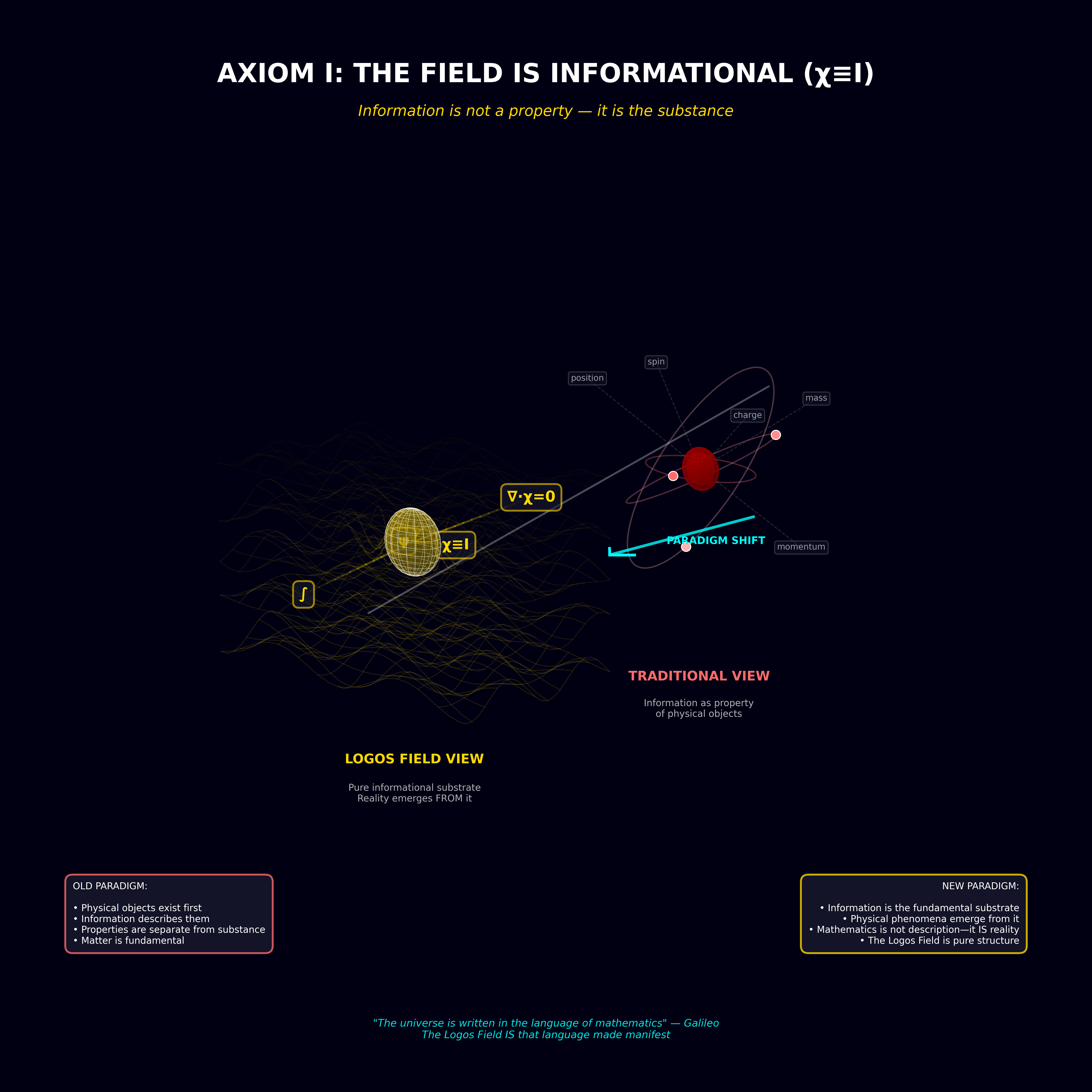
If reality is information, and information is organized, then the universe is not fundamentally *stuff* — not matter, not energy, not fields vibrating in a void. The universe is fundamentally *language*. It is structured communication. It has syntax (the laws of physics). It has grammar (the mathematical relationships between those laws). It has a vocabulary (the elementary particles and forces). And it has a resolution — a Planck-scale pixel grid that sets the precision of every sentence the universe can write.
Science spent three centuries assuming the question was: *what are the laws that govern matter?*
Bekenstein showed that the question is: *what is the language that defines reality?*
This is not a mystical claim. It is the direct, unadorned reading of the mathematics. The Bekenstein Bound is a data cap. The Planck length is a pixel size. The holographic principle says the information is the thing, and the physical world is the projection.
And yet — and this is where the discomfort lives, where it has lived since 1972 — if the universe is a language, then the deepest question in physics is not about forces or particles or fields. It is about the *speaker*. Languages do not write themselves. Codes do not emerge from noise. A Bekenstein Bound implies a boundary condition, and a boundary condition implies something that set it.
Bekenstein himself was not loud about this implication. He was a physicist, not a theologian, and he understood the professional consequences of crossing that line. But the formula doesn't care about professional consequences. It sits there, confirmed to every decimal place anyone has ever tested, and it says: the foundation of reality is structured information with a finite resolution and a maximum capacity.
That's not a universe made of things. That's a universe made of *words*.
And if the universe is a language, then somewhere — before the first word was spoken, before the first bit collapsed into a definite state — there was a Logos.
Not a metaphor. A mathematical necessity.
> [!abstract]- Canonical Navigation
> - Next: [[Chapter 2 The Universal Computer]]
> - Series: [[Logos Story Index]]
> - Framework: [[00_Canonical/MASTER_EQUATION_10_LAWS/Law_06_Information_Logos/Computational_Universe_(Lloyd)|Computational Universe (Lloyd)]]