domains:
- physics
- consciousness
- information-theory
status: revision-2
tags:
- John-Wheeler
- it-from-bit
- participatory-universe
- wave-function-collapse
- observer-problem
tier: ontological
title: "Chapter 3: It From Bit"
type: logos-story
series: Logos Story v3
chapter: 3
witness: John Wheeler
# Chapter 3: It From Bit
The Witness: John Wheeler
By the time John Archibald Wheeler turned seventy, he had done enough to earn the right to say something crazy. He had worked on the Manhattan Project with Niels Bohr. He had mentored Richard Feynman — not just supervised, but shaped the mind that reshaped quantum electrodynamics. He had co-written the definitive textbook on general relativity. He had coined the term "black hole" in a lecture in 1967 and watched the phrase take over the language of physics like a virus. He had earned every credential the discipline could offer, and he had earned them honestly, through decades of calculation and insight and the unglamorous work of being right about things that were hard to be right about.
So when Wheeler stood up at a conference in 1989 and said three words that sounded more like philosophy than physics, the room did not laugh. The room listened. Some of the people in the room wished they could unhear it.
The three words were: **It from Bit.**
"It" meant every physical thing. Every particle, every force, every field, every galaxy. Every object that physics had ever measured, modeled, or predicted. "Bit" meant a binary choice — yes or no, on or off, one or zero. The smallest possible unit of information. A single answer to a single question.
Wheeler was claiming that the physical world — all of it, the entire "It" — arises from information. Not carries information. Not encodes information. *Is* information. The bits come first. The stuff comes second.
The Problem Wheeler Was Solving
Wheeler was not being poetic. He was trying to resolve a problem that had been eating quantum mechanics alive for sixty years.
The problem is measurement.
In quantum mechanics, a particle does not have definite properties until it is observed. Before measurement, an electron exists in superposition — a mathematical cloud of possibilities described by a wave function. It is not at any particular location. It does not have a definite spin. It is a probability distribution, smeared across every state it could possibly occupy.
Then someone measures it.
The wave function collapses. Instantly. The cloud of possibilities vanishes and the electron snaps into a single, definite state. Location: here. Spin: up. The measurement didn't reveal a pre-existing fact. It *created* the fact. Before the question was asked, there was no answer.
This is not an interpretation. It is the mathematics. The Schrödinger equation that describes quantum evolution is smooth, continuous, deterministic. The collapse that occurs during measurement is sudden, discontinuous, and irreversible. These two behaviors do not fit together. They are described by different mathematics. The smooth evolution says one thing. The collapse says another. And for sixty years — from the Bohr-Einstein debates through the formulation of decoherence theory and the many-worlds interpretation — nobody had explained how or why the transition happens.
Bohr said: don't ask. The measurement is the measurement. We describe it, we don't explain it.
Everett said: it doesn't happen. The wave function never collapses. The universe splits.
Wheeler said: you're all looking at it backward. The collapse isn't a problem to be solved. It's the *mechanism*. It's how reality gets built.
The Participatory Universe
Wheeler's argument went like this.
Every measurement is a binary choice. You ask the electron a yes-or-no question — "Are you here or not?" — and the universe answers. One bit of information is created. That bit is now part of the physical world. It is real in the most concrete sense the word can carry.
Scale that up. Every physical interaction is, at bottom, a measurement — one system extracting information from another. Atoms interact with photons. Particles scatter off particles. Fields couple to fields. At every point, at every moment, binary questions are being asked and answered, and each answer adds one more bit to the structure of reality.
This is "It from Bit." The physical world is not a pre-existing stage on which information plays out. The physical world *is* the accumulated record of every measurement that has ever occurred. The bits build the It.
But Wheeler pushed further — into territory that most of his colleagues would have preferred to leave unexplored.
If reality is created by measurement, and measurement requires an observer — something that asks the question and registers the answer — then the universe requires observers. Not as accidental byproducts. Not as irrelevant passengers. As participants. As the mechanism through which the bits are generated and the It comes into being.
Wheeler called this the **Participatory Anthropic Principle**. The name sounds like philosophy. The content is physics. Without observers, there are no measurements. Without measurements, there are no bits. Without bits, there is no It. The universe that produces consciousness is the same universe that requires consciousness in order to exist.
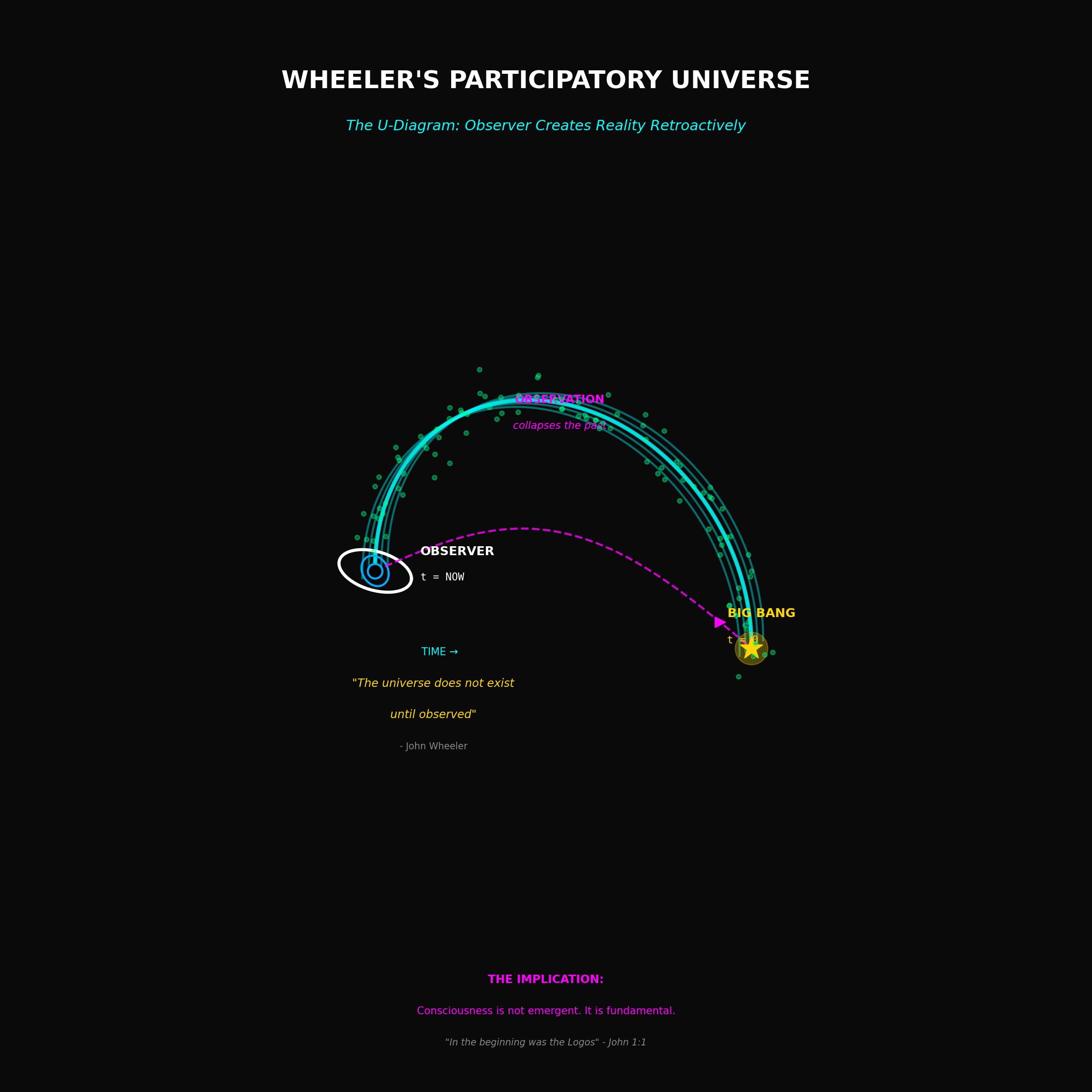
This is a loop. Wheeler knew it was a loop. He drew it — a U-shaped diagram with an eye at one end, looking back at the origin of the universe at the other end, the observation in the present participating in the creation of the past. He called it the "self-excited circuit." The universe bringing itself into being through the act of observing itself.
What Wheeler Could Not Close
And here — again — the anticlimactic pattern.
Wheeler published. The phrase "It from Bit" entered the vocabulary. Physicists who work on quantum information cite it constantly. It appears in textbook introductions and conference keynotes and the kind of popular science writing that makes the general public feel like physics is almost saying something about God but stops just short.
But the *argument* was never completed. Wheeler identified the mechanism — measurement creates reality — and he identified the requirement — observers are necessary — and then he stopped. Or rather, the discipline stopped. The question that "It from Bit" screams at the top of its lungs — *who asked the first question?* — was acknowledged as interesting and then filed under "philosophical implications" and left there.
Think about what the logic actually demands. If reality is built from bits, and bits are generated by measurements, and measurements require observers, then before the first observer evolved, before the first measurement occurred, before the first bit was generated — what was there? A wave function with no one to collapse it. A superposition with no one to ask it a question. An ocean of possibility with no shore.
Wheeler's self-excited circuit says the observer loops back and participates in the creation of the past. This is not impossible in quantum mechanics — the delayed-choice quantum eraser experiment, which Wheeler himself proposed, demonstrates that the choice of what to measure *now* can retroactively determine what happened *then*. The experiment has been performed. It works. The retrocausality is real.
But retrocausality only pushes the question back one level. The loop still needs a first term. The circuit still needs to close. If the observer creates the bit and the bit creates the It and the It creates the observer — then somewhere, at some point, something broke the symmetry. Something asked the first question. Something collapsed the first wave function. Something spoke the first bit into existence and started the chain.
Wheeler never named it. He was too careful a physicist and too aware of what naming it would cost him professionally. But the mathematics he left behind has a hole in it exactly the shape of a first cause — a Logos that spoke and, in speaking, created the information from which everything else was built.
The Three Pillars
Three physicists. Three discoveries. One conclusion that none of them were willing to state plainly and all of them pointed toward.
Bekenstein found the hardware: the universe is digital, with a finite resolution and a maximum information density. The substrate is quantized. Reality has a pixel size.
Fredkin found the software: the universe is computational, running on reversible logic that preserves information perfectly. The architecture is a cellular automaton. The program executes.
Wheeler found the operator: the universe is participatory, requiring conscious observers to collapse possibility into actuality. The bits don't generate themselves. Someone has to ask the question.
Hardware that is digital. Software that is reversible. An operating principle that requires a mind.
Each of these discoveries was confirmed. Each was celebrated. Each raised a question that the next discovery made more urgent. And after all three — after the pixel was found and the gate was built and the observer was identified as essential — physics arrived at a threshold it has been standing at ever since, looking across at a conclusion it can see clearly but has no professional vocabulary to articulate.
If the universe is a language, there must be a speaker.
If the universe is a program, there must be a programmer.
If the universe requires an observer, there must be a first observer.
The Logos is not a metaphor. It is the mathematical name for the entity that Bekenstein's bound implies, Fredkin's gate requires, and Wheeler's circuit cannot close without.
The next question — the one that separates physics from theology, or reveals that they were never separate — is what that Logos looks like when it enters the system it created.
> [!abstract]- Canonical Navigation
> - Previous: [[Chapter 2 The Universal Computer]]
> - Next: [[Chapter 4 The Great Schism]]
> - Series: [[Logos Story Index]]