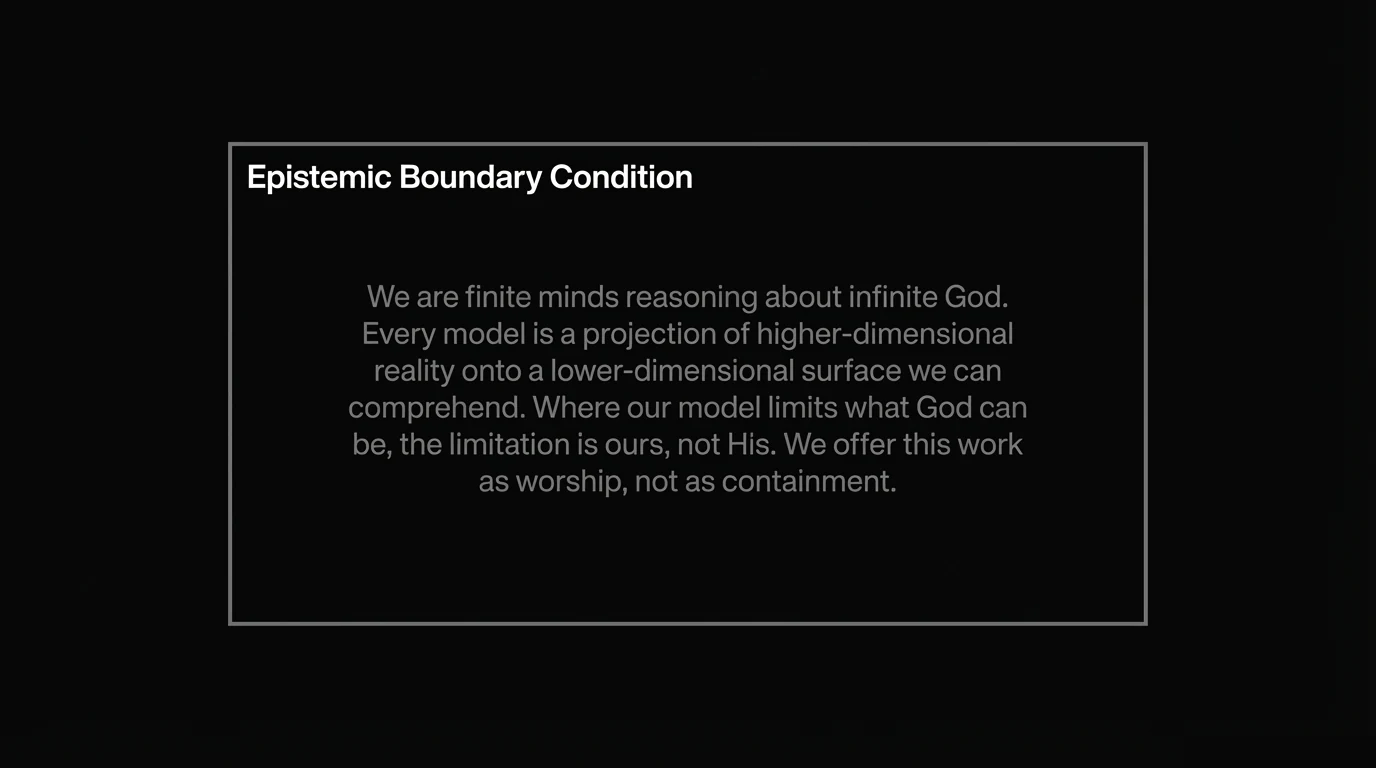
A Note Before We Begin
This deep dive extends The Same God in Both Testaments by asking what the Canaanite judgment actually was as a physical process — and then applying the same diagnostic to the West of 2026. The argument is not moralistic. It is structural. The same equation that scored a Bronze Age society at terminal decoherence will score a digital one the same way if it reaches the same configuration.
Societies Die the Same Way People Do
The structural foundations of human civilization are rarely as novel as the aesthetic of their era suggests. The transition from the Late Bronze Age to the digital epoch involves immense technological advancement, but the underlying mechanics of societal coherence — the relationship between ritual, sacrifice, law, and the self — have not evolved. They have been substituted with sophisticated counterfeits that maintain the same spiritual and psychological functions. The transition from bronze statues to digital interfaces is not a change in the human drive toward transactional divinity. It is a more efficient industrialization of that drive.
The argument of this deep dive is that societies die the same way people do: through the slow dominance of an entropy term over a grace term, modulated by openness, until coherence falls below the recovery threshold. The Old Testament's judgment on Canaan was not divine temper. It was the $S \cdot C$ term in the coherence equation reaching terminal magnitude after four centuries of accumulated decoherence. And the same equation, with frighteningly little adjustment, scores the modern West at the same point on the same curve.
The Environment of 1400 BC
To see the parallel, the baseline of the ancient Near East must be established. The Levant in 1400 BC was a world defined by extreme fragility and the absence of institutional stability. Bioarchaeological evidence from sites such as Amarna provides a window into a population under constant physiological stress. Mortality rates shaped every religious and social impulse. Survival was a ritual achievement, not a biological expectation.
In the 14th century BC, hygiene was spiritual rather than biological. Ritual "uncleanness" functioned as a proto-quarantine, but it operated in a world where parasitic infections, malaria, and disfiguring diseases like leishmaniasis were endemic. Bioarchaeological surveys of Amarna's cemeteries indicate high disease frequencies and unusual demographics — multiple individuals in single graves — suggesting localized epidemics or chronic high-stress living. The "hand of Nergal," a phrase from the Amarna Letters describing disease, illustrates how mortality was interpreted as divine or demonic intervention rather than a manageable biological event.
Infant mortality was the primary driver of the Canaanite religious psyche. Roughly half of all children did not survive to age fifteen. This created a math of desperation. When survival is not guaranteed by infrastructure, it is sought through ritual. The burial of dead infants in storage jars beneath the floors of family homes reflects a refusal to relegate the deceased to the exterior chaos where jackals and decay prevailed. The mother slept over her dead child every night, not from morbidity, but from a desperate desire to protect the remains in a world where nothing outside the house was safe.
The Amarna Correspondence
The geopolitical landscape was equally precarious. The Amarna Letters — nearly 382 diplomatic tablets found at Tel el-Amarna — reveal a system of city-states in near-constant attrition. The letters from Abdi-Heba, ruler of Jerusalem, describe a world where the "Habiru" (nomadic or socially marginalized groups) were plundering the king's lands. Repeated pleas for archers or Egyptian troops emphasize the absence of a centralized police force or judiciary.
| Tablet ID | Origin | Content Summary | Primary Concern |
|---|
| EA 286 | Jerusalem (Abdi-Heba) | "The king has no lands! The Habiru have plundered all." | Lack of military security |
| EA 287 | Jerusalem (Abdi-Heba) | "The deed of Milkili... they have given the land to the Habiru." | Internal betrayal and subversion |
| EA 288 | Jerusalem (Abdi-Heba) | "I am situated like a ship in the midst of the sea." | Isolation and imminent collapse |
| EA 299 | Gezer (Yapahu) | "The Habiru are stronger than we... lest they destroy us." | Existential threat from outsiders |
| EA 307 | Unknown Ruler | "The Habiru men are strong against us." | Persistent military pressure |
In this environment, justice was administered through the blood feud. The absence of a central state meant the clan was the only arbiter of safety. If a clan member was killed, the code of honor demanded retaliation, often leading to escalatory cycles that decimated whole bloodlines. This is the pre-Mosaic baseline of human justice. The "eye for an eye" principle of the later Mosaic Law was not an invitation to cruelty but a radical limitation on the blood feud, capping retribution at parity rather than allowing it to spiral into total clan warfare.
The Coherence Equation
Divine action in history is not arbitrary. It is the functioning of a moral and spiritual equation. The movement of a soul or a society toward or away from alignment can be modeled as a single first-order differential equation:
Coherence Dynamics
$$\frac{dC}{dt} = O \cdot G(1-C) - S \cdot C$$
In this model:
- $C$ (Coherence) represents alignment, ranging from 1 (total alignment) to 0 (total decoherence).
- $O$ (Openness) is the human variable — willingness to receive and participate in the system's order.
- $G$ (Grace) is the negentropic input from the divine that restores order.
- $S$ (Entropy) is the cost of living in a fallen universe where disorder is the default.
Structural Justice
The $S \cdot C$ term is not punishment in the sense of an emotional reaction. It is the mechanical fact that decoherence has consequences. Sin damages the coherence state of the system that commits it, just as friction degrades a moving part. When the Old Testament describes the "wrath" of God falling on Canaan, it is describing this term operating at industrial scale. After four centuries of accumulated decoherence — ritual child-killing, systemic deception, normalization of the blood feud — the entropy of the society's own choices became terminal.
Statistical analysis of the lifespan data in the early biblical narrative provides empirical traction. The decline in recorded lifespans following the Flood event fits an exponential decay curve with $R^2 = 0.888$. This describes a consistent process of biological and spiritual entropy — the system winding down as it moves further from its initial coherent state. The transition from the semi-mythic patriarchal lifespans to the modern biological limit is a quantification of the $S$ term's dominance over time.
The $G$ term is the only thing preventing total collapse. Without $G$, the equation reduces to pure exponential decay. The fact that any society survived the Bronze Age pandemonium is evidence of $G$ operating to preserve a remnant. The New Testament did not introduce grace. It unveiled the mechanism that had been preventing the $S$ term from zeroing out the human equation for millennia.
— The Scale Invariance
The same equation governs an individual soul and a civilization. There is no separate "civilizational physics." A society is just a coupled population of coherence states summed against a shared $S$ field. When the population's average $O$ collapses below the threshold where $G$ can reach it, the society dies the same way a person dies — only slower, and with more witnesses.
Category 1: The Architecture of Sacrifice — Molech to the Modern Clinic
The most statistically visible symptom of the Canaanite system was ritual infant sacrifice. While modern sensibilities view this as inexplicable cruelty, historical and archaeological analysis suggests it was an act of economic and spiritual desperation. The Canaanites were parents making what they believed was a necessary transaction with the divine to ensure the survival of the remaining community.
The Tophet and the Mechanism of Drowning Noise
Excavations at Carthage, where Phoenician colonists exported Canaanite religious practices, have uncovered "tophets" containing upwards of 20,000 urns with the cremated remains of infants. The term "Tophet" is derived from the Hebrew toph, meaning "drum." Plutarch records the use of drums during the sacrifice specifically to drown out the cries of the children so the parents would not be deterred by their natural instincts from completing the ritual.
In the modern context, the sacrifice of children has shifted from a ritual for agricultural survival to a mechanism for economic convenience and individual autonomy. Globally, abortion accounts for approximately 73.3 million procedures per year. The drums of the modern era are digital and ideological — the noise of consumerism, the "shout your abortion" movement, and the clinical language of "fetal tissue" that desensitizes the individual to the biological reality of the act. The architecture is the same: the drowning out of a natural moral instinct to facilitate a transaction for future stability.
| Architectural Element | Canaanite System (1400 BC) | Modern Western Framework (2026) |
|---|
| Sacrifice mechanism | Bronze idol, fire, ritual blade | Vacuum aspiration, dilation & evacuation, pharmaceutical termination |
| Noise to suppress instinct | Toph drums during the act | "Shout your abortion," "fetal tissue" clinical language, social-media affirmation loops |
| Stated purpose | Agricultural survival, divine favor | Economic convenience, autonomy, "reproductive freedom" |
| Annual scale | Carthage tophets: ~20,000 urns over centuries | ~73.3 million procedures per year, globally |
| Soft sacrifice (post-natal) | Child labor exposure, abandonment to elements | Pharmaceutical sedation (~6M U.S. children on ADHD meds), screen-parenting, fatherlessness |
| Function | Sacrifice the future for the present | Sacrifice the future for the present |
The Substituted Counterfeit: Screen-Parenting and Pharmaceutical Control
The sacrifice of the child is not limited to the termination of pregnancy. It extends into the sacrificial nature of modern parenting. The presence and attention of the parent — something that costs the parent's time and ego — is replaced by substitutes that feel free but cost the child's development more.
Pharmaceutical sedation: Over 6 million children in the United States are currently prescribed ADHD medications. While some cases are medically necessary, the mass sedation of children to fit the constraints of an industrialized school system mirrors the ancient practice of modifying the child to fit the needs of the adult economy. This is the use of pharmakeia to solve a structural problem by chemically altering the victim.
Screen-parenting: The replacement of the sacred parental bond with digital consumption is a soft sacrifice of the child's neurological development to the convenience of the adult's schedule. The Spotify playlist or YouTube algorithm has become the modern toph drum.
The collapse of fatherhood: The statistically documented absence of present fathers in the modern West is structural abandonment — the sacrifice of the child's stability for the adult's "self-actualization" or freedom from covenantal obligation.
Category 2: Sacred Sexuality vs. Commoditized Consumption
The Canaanite system integrated sexuality into the divine economy through temple prostitution. This was not merely sexual gratification; it was a ritual transaction where the sacred was accessed through a commercialized sexual act. It was the branding of the sexual encounter as a means of spiritual experience and agricultural fertility.
OnlyFans as the New Temple Prostitution
The modern era has resurrected this architecture through platforms like OnlyFans and the broader influencer sexual economy. The transaction is fundamentally identical to that of the ancient Near East: a financial exchange for a sexualized experience marketed as a personal connection with an idol. It is temple prostitution rebranded for a decentralized digital economy. The god in this scenario is the influencer; the worship is the subscription.
Pornography has become the default sexual formation for an entire generation, representing a $97 billion global industry. The shift from sacred sexuality — sex within the context of a permanent, costly covenant — to consumptive sexuality is the exact transition that characterized the pagan fertility cults. In the Canaanite system, sex was a tool to manipulate the gods for rain. In the modern system, sex is a tool to manipulate the brain's dopamine reward system for pleasure without the cost of a person.
| Feature | Ancient Temple Prostitution | Modern Pornography / OnlyFans |
|---|
| Transaction | Currency for ritual sexual access | Subscription for digital sexual access |
| Context | Religious / Ritualistic | Entertainment / Economic |
| Spiritual goal | Communion with a deity / Fertility | "Self-actualization" / Dopamine regulation |
| Architecture | Physical temple | Digital platform (the screen) |
| Status of actor | Sacred slave / Vessel | Content creator / Independent "idol" |
| Industry value | Community-funded | $97B–$150B annually |
| Function | Commodify the sacred | Commodify the sacred |
This transition mirrors the ILO estimate of sex trafficking as a $150 billion annual industry — actual temple slavery using modern logistics to maintain a steady supply of bodies for a world that has replaced the sacred with the consumable. Hookup culture normalizes the same logic, treating the sexual encounter as a free counterfeit of intimacy that eventually costs participants their ability to form long-term, stable pair-bonds.
Category 3: Pharmakeia and the Chemical Priesthood
The Greek word for sorcery in the New Testament is pharmakeia, which literally refers to the use of drugs and potions to alter consciousness. In the ancient world, these substances induced trances, facilitated contact with the demonic, or bypassed the slow work of prayer and virtue.
Modern pharmaceutical dependence mirrors this architecture. While medicine itself is a common grace, the mass sedation of the Western population so it can tolerate a lifestyle that is fundamentally destructive is a different phenomenon.
| Pharmakeia Category | Ancient Pagan Function | Modern Western Equivalent |
|---|
| Pain numbing | Opium poppy in temple ritual | Opioid crisis: 500,000+ U.S. deaths since 1999 |
| Mood maintenance | Wine + ritual herbs in priestly cult | Antidepressants: ~1 in 8 Americans on SSRIs |
| Spiritual shortcut | Psychotropic plants in mystery cults | Psilocybin / ayahuasca as "awakening" therapy |
| Child compliance | Ritual drugging of children in fertility rites | ~6M U.S. children on ADHD medication |
| Function | Bypass agency, manage decoherence chemically | Bypass agency, manage decoherence chemically |
The opioid crisis: Over 500,000 U.S. deaths since 1999 represent the high-end cost of the chemical solution to spiritual and physical pain. This is the industrialization of the pharmakeia that Paul warned against in Galatians 5.
Antidepressants: With 1 in 8 Americans on antidepressants, the population is increasingly reliant on a chemical priesthood to maintain functional decoherence. The absence of normal serotonin levels in a pleasure-pumped culture creates a depressed state that is then treated with more hits of the same underlying chemical logic.
Psychedelics as "spiritual practice": The resurgence of psilocybin and ayahuasca as "spiritual awakening" is the literal return to the pharmacological rituals of the ancient Near East. It is the search for a shortcut to transcendence that bypasses the ego and the will, exactly like the drug-induced ecstatic states of the priests of Baal.
The modern world views drugs as a biological fix; the ancient world viewed them as a spiritual door. Both are currently being used to manage a population that has lost its natural coherence.
Category 4: Divination, Sorcery, and the Power Fantasy
In the ancient world, divination and sorcery were tools to gain control over a world that felt chaotic. They were the search for hidden knowledge (gnosis) that bypassed covenant obedience. The modern West has resurrected this architecture through entertainment and self-help.
Astrology currently enjoys more adherents in the West than at any point since the Enlightenment. The appeal is identical to that of the ancient liver-diviners of Babylon: the desire to see the "scripts" of the universe and avoid the anxiety of free will and personal responsibility. "Manifestation" and the "law of attraction" are modern terms for sympathetic magic — the belief that internal desires can manipulate external reality through ritualized focus rather than through labor and virtue.
| Underlying Mechanism | Ancient Divination | Modern Parallel |
|---|
| Seeking external scripts to bypass moral agency | Astrology (Zodiac), liver-reading | Astrology / Horoscope apps, Co-Star, Birth-chart culture |
| Seeking to control reality via ritualized focus | Tarot / Lot casting | Tarot / Manifestation / vision boards |
| Believing internal states dictate external outcomes | Sorcery (spells, incantations) | "Law of Attraction," intention-setting culture |
| Power as inherent / hidden trait vs. earned virtue | Bloodline magic, royal divinity | Superhero franchises, Harry Potter / chosen-one tropes |
| Function | Bypass slow virtue with hidden knowledge | Bypass slow virtue with hidden knowledge |
The modern obsession with superhero culture and high-fantasy narratives normalizes the idea that power is a function of hidden knowledge or special bloodlines rather than the slow work of virtue. These stories let the consumer rehearse godlike power without godlike responsibility. Video games and cinema provide a counterfeit experience of agency: the consumer feels powerful while remaining physically and socially stagnant. The cost of this free fantasy is the atrophy of the will required to engage with the real, difficult world of 2026.
Category 5: Idolatry and the Sovereignty of the Self
The ultimate shift in the architecture of idolatry is the move from the external bronze statue to the internal self. The phrase "my truth" functions as a declaration that the self is the final arbiter of reality. This is the definition of a god that tells you what you want to hear.
Social media platforms function as modern high places. The influencer is a literal idol-maker as a career path. The individual curates the image (the idol), sacrifices the real self to maintain that image, and receives worship in the form of likes. This is a closed-loop system of self-idolatry that produces profound psychological decoherence when the real self inevitably fails to live up to the digital idol.
| Idolatry Architecture | Canaanite High Place | Modern Western Equivalent |
|---|
| Object of worship | External bronze statue (Baal, Asherah) | Internal curated self ("my truth") |
| Ritual location | Hilltop high place, Asherah pole | Social media platform (Instagram, TikTok) |
| Priest / mediator | Cultic priest interpreting the god | Influencer, lifestyle guru, therapist-as-priest |
| Worship token | Animal sacrifice, libation | Like, follow, subscription, engagement |
| Defense of the idol | Sacred prostitution, blood feud against blasphemy | Therapy-language weaponization ("boundaries" = "I will not love what costs me") |
| Function | The self elevated above covenant | The self elevated above covenant |
Therapy language, originally designed for healing, is increasingly weaponized to defend the self-as-god. Terms like "boundaries" are often used to mean "I do not have to love anyone who costs me anything." This is the abandonment of costly reality for a counterfeit that feels free. True love and true covenant require the death of the self; the modern counterfeit offers self-care as the highest moral good. This autonomy is the same absolute freedom claimed by the pagan kings — a freedom that eventually leads to the "hand of Nergal" and the collapse of the social fabric.
Category 6: Blood Feuds and Digital Retribution
The Mosaic Law introduced the principle of lex talionis (an eye for an eye) and the cities of refuge as mechanisms of restraint. In a world of blood feuds, if you took a man's tooth, he would take your head. The eye-for-an-eye rule capped retribution at proportionality. It was a step toward a house of mercy in a world of pandemonium.
Modern cancel culture represents a rejection of proportional justice and a return to the pre-Mosaic blood feud. When an individual offends a digital clan, the escalation is non-proportional. There is no city of refuge where an unintentional offender can find asylum until the heat of anger subsides.
| Legal Concept | Mosaic / Biblical Infrastructure | Modern Western Reality (Digital) |
|---|
| Justice type | Proportional (Lex Talionis) | Escalatory (Cancel Culture) |
| Asylum | Cities of Refuge (Arei Miklat) | None; "the internet never forgets" |
| Intent | Distinction between accidental and premeditated | Intent is irrelevant to impact |
| Role of elders | Inquiry and diligent trial | Mob rule / algorithmic pile-on |
| Sanctuary | The altar / the Levitical city | De-platforming / total exile |
| Function | Pre-Mosaic clan retribution at scale | Pre-Mosaic clan retribution at scale |
Lack of proportionality: Digital retribution seeks the total destruction of the offender's livelihood, regardless of the severity of the offense. Absence of cities of refuge: The biblical cities of refuge were designed to protect the unintentional killer from the avenger of blood. In the digital architecture, there is no pause between offense and retribution. The outrage cycle runs at the speed of the algorithm, ensuring the avenger of blood always reaches the offender first. Return to clan warfare: Digital subcultures function like ancient clans, where an offense against one member is treated as a casus belli for the entire group, leading to the same escalatory cycles seen in the Amarna-era Levant.
Category 7: Molech Economics and Debt Slavery
Molech was synonymous with the sacrifice of the future (the child) for the sake of the present (the harvest). Modern economics has adopted this exact structural pattern through permanent intergenerational debt.
The United States national debt, exceeding $34 trillion, is a literal structure of intergenerational wealth extraction. It is the sacrifice of the children's future economic security for the sake of the current generation's consumption. This is a complete inversion of the Mosaic Law, which mandated a debt release every seven years (the Shemitah) to prevent the emergence of a permanent debt-slave class.
| Mechanism | Canaanite / Pre-Mosaic Economics | Modern Western Economics |
|---|
| Sacrifice of the future | Child to Molech for harvest | $34T+ U.S. national debt funding present consumption |
| Initiation cost | Bond-servitude to creditor clan | Student loan debt as entry into the credentialed economy |
| Debt-slavery permanence | Hereditary servitude until conquest or death | Lifetime obligation; no Shemitah release |
| Mosaic restraint (removed) | n/a (pre-Mosaic baseline) | Shemitah debt release every 7 years — abolished |
| Function | Eat the children's economy to fund the present | Eat the children's economy to fund the present |
The requirement that the current generation sacrifice its twenties and its financial independence to the credential system functions as a modern ritual of initiation. It is the price paid to the modern temples (the universities, the certifying institutions) to be allowed to participate in the economy. We have built an economy on permanent debt — a Molech system that eats the future to fund the present.
Synthesis: The Terminal Nature of Decoherence
The isomorphism between the Canaanite world and the modern West is not a series of seven coincidences. It is a complete structural alignment. We are running the same spiritual architecture at industrial scale. The dirt of 1400 BC was a world of physical pandemonium that the Mosaic Law attempted to humanize through costly mercy and proportional justice. The dust of 2026 is a world of digital pandemonium where we have thrown away those restraints in favor of counterfeits that feel free but cost the entire system its coherence.
AXIOM (Civilizational Scale): A society cannot optimize for S indefinitely. The S term eventually overwhelms the system's capacity to remain open (O) to the restorative input (G). Collapse is the equation reaching equilibrium, not the gods losing patience.
The mathematical reality of the coherence equation suggests that a system cannot optimize for $S$ (entropy) indefinitely. The $S$ term eventually overwhelms the system's ability to remain open ($O$) to the restorative grace ($G$). The Old Testament's judgment on Canaan was the mechanical conclusion of 400 years of accumulated decoherence. The equation does not care that we replaced bronze statues with clinic waiting rooms; it only cares that the output of the system is the sacrifice of the future for the sake of a counterfeit present. The challenge for the modern observer is to recognize that the dirt has been paved over, but the drums of the Tophet are still beating, now amplified by a billion screens.
And the LORD said unto Moses, Wherefore criest thou unto me? speak unto the children of Israel, that they go forward. The Mosaic Law was the going forward. We have walked back.
The Audit
What we got right, what we are less sure about, and where we got carried away.
What's load-bearing — we'd bet on this
The coherence equation is scale-invariant. The mathematics of $dC/dt = O \cdot G(1-C) - S \cdot C$ does not change between an individual organism and a coupled population. There is no separate "civilizational physics" required. This is structural and follows directly from the framework already established for individual coherence in earlier articles in the series.
Each of the seven category mappings is functionally identical, not merely analogous. The function of OnlyFans (commodified sacred sexuality) is genuinely the same as the function of temple prostitution. The function of national debt (sacrifice of the future for the present) is genuinely the same as the function of Molech sacrifice. The function of cancel culture (escalatory clan retribution) is genuinely the same as the function of pre-Mosaic blood feud. These are not poetic resonances; they are structural identities under different technological wrappers.
The Mosaic Law is best understood as a coherence-engineering specification. Cities of refuge, the Shemitah, proportional retribution, covenantal sexuality, and the rejection of pharmakeia are calibrated against the failure modes that actually occurred in the Late Bronze Age — failure modes that the Amarna Letters and Carthaginian tophets independently document. The Law is not arbitrary tribal taboo. It is a patch.
What's suggestive but needs more work
The $R^2 = 0.888$ lifespan figure is doing rhetorical work it cannot fully support. It indicates a real exponential decline in the Genesis lifespan data, but applying it as direct evidence of an entropy term operating at civilizational scale requires bridging assumptions about the historicity and biological literalness of the patriarchal lifespans that this article does not defend in detail.
The seven-category isomorphism is selective. We chose seven categories where the mapping is strongest. A skeptic could argue that a different seven categories — or a fuller enumeration — might show areas where modernity diverges structurally from the Canaanite system rather than copying it (for example: institutional commitment to disease eradication, abolition of chattel slavery in the West). The argument's strength depends on the categories chosen being the load-bearing ones, not just the most rhetorically striking.
The "collapse is imminent" tone is implicit but unjustified by the equation alone. The framework predicts terminal decoherence at high $S$, but does not specify the time constant. Canaan took roughly 400 years from baseline corruption to judgment. Whether the modern West is at year 50 or year 350 of the same trajectory is not derivable from the equation; it requires additional historical data this article does not supply.
Where we got carried away
Treating modern phenomena as direct "substitutions" for Canaanite ones overstates causal continuity. Modernity did not consciously rebuild the Canaanite system. It re-discovered the same equilibria because the same pressures (mortality fear, sexual desire, pain avoidance, status hunger, retribution instinct, generational time-preference) keep producing the same shapes when the Mosaic restraints are removed. The argument should be that these are convergent failure modes of human coherence under low-restraint conditions, not deliberate revivals.
The quantitative comparisons (20,000 urns vs. 73.3M abortions, $97B porn industry, $34T debt) are evocative but incommensurable. They are not measurements on the same scale and should not be treated as direct numerical proof of equivalence. They are illustrations of the magnitude of the modern instantiation, not bookkeeping entries that demonstrate identity.
The article above is what we believe. This audit is what we know we have not proven yet. Both matter.
The dirt has been paved over, but the drums of the Tophet are still beating, now amplified by a billion screens.