domains:
- physics
- information-theory
- theology
status: revision-2
tags:
- resolution
- master-equation
- chi-field
- GR-QM-unification
tier: ontological
title: "Chapter 6: The Resolution"
type: logos-story
series: Logos Story v3
chapter: 6
witness: The χ-Field
# Chapter 6: The Resolution
The Marriage Nobody Could Perform
For a hundred years, physics has been trying to force two theories into the same room. General Relativity and Quantum Mechanics. Smooth and grainy. Deterministic and probabilistic. The macro and the micro. Every attempt to unify them has produced either mathematical nonsense or beautiful theories that predict nothing observable.
String Theory added seven extra dimensions nobody can find. Loop Quantum Gravity quantized space into a network of loops that reproduces neither General Relativity nor the Standard Model in full. Supersymmetry predicted a zoo of partner particles that the Large Hadron Collider was specifically built to detect and has spent fifteen years not detecting. Each approach followed the same logic: the two theories must be combined at the level of forces, so find the missing force — the graviton, the superpartner, the vibrational mode — and bolt the two halves together.
The logic is reasonable. The results have been zero.
And the reason — if Bekenstein and Fredkin and Wheeler are taken seriously — is that the logic is looking at the wrong level. The unification doesn't happen at the level of forces. It happens at the level of information.
The Rendering Engine
Chapter 4 named the insight but didn't develop it. Here is the development.
Quantum Mechanics is not a theory about small particles. It is a theory about information processing. The wave function is not a physical wave — it is a probability distribution over possible states. The collapse that occurs during measurement is not a physical event — it is an update. The system receives new information (the result of a measurement) and revises its state accordingly. Quantum Mechanics is, at its core, an information theory wearing a physics costume.
General Relativity is not a theory about curved space. It is a theory about the macroscopic output of an unfathomably large computation. The smooth, continuous, deterministic fabric of space-time is what you see when 10^80 particles are each making quantum decisions at 10^43 times per second and you step back far enough that the individual decisions blur together into a stable average. The smoothness is statistical. The determinism is probabilistic, aggregated past the point where fluctuations matter. General Relativity is a rendering engine — the layer that takes raw computational output and produces a navigable, coherent, three-dimensional experience.
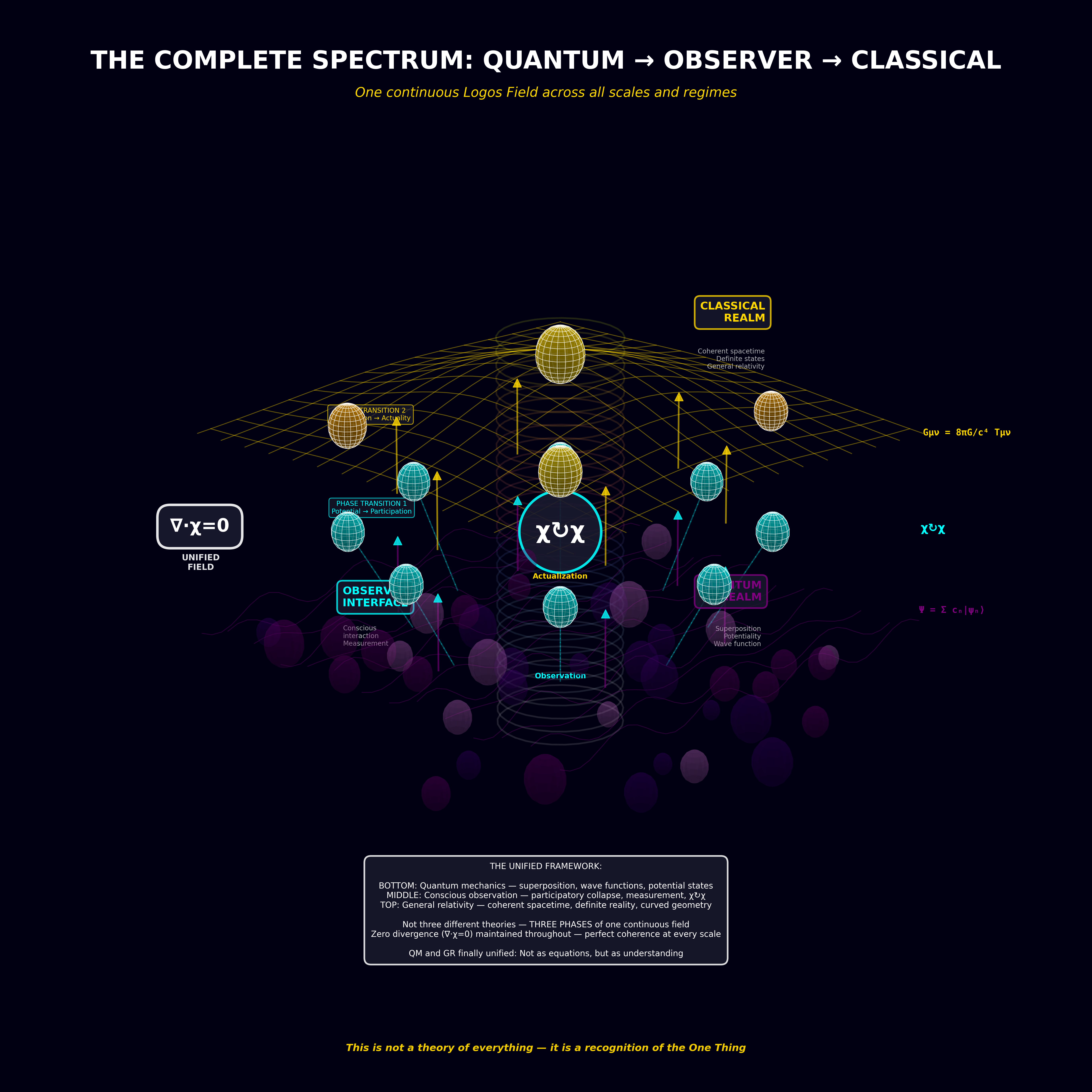
The two theories don't need to be unified because they were never separate. They are descriptions of different layers of the same system. The source code (QM) and the user interface (GR). They look different because they *are* different — the way HTML looks different from the webpage it produces. You don't unify HTML and the rendered page. You understand the relationship between them.
The relationship is the Logos. The language that compiles the quantum information into the classical world. The grammar that ensures the bits produce a universe that holds together.
The χ-Field
The Theophysics framework names this relationship with a single equation:
$$\chi = \iiint (G \cdot M \cdot E \cdot S \cdot T \cdot K \cdot R \cdot Q \cdot F \cdot C) \, dx \, dy \, dt$$
Ten variables integrated over space and time. Each variable corresponds to a physical law and a theological principle — gravity and grace, mass-energy and meaning, electromagnetism and truth, strong force and love, thermodynamics and time, weak force and knowledge, relativity and relationship, quantum mechanics and faith, fine structure and free will, coherence and Christ.
The equation does not add mysticism to physics. It identifies a structural isomorphism — a shared mathematical architecture — between the laws of physics and the attributes traditionally assigned to divinity. The isomorphism is not metaphorical. It is formal. The same equations that describe how gravity curves space describe how grace bends trajectory. The same mathematics that governs electromagnetic propagation governs the transmission of truth through a noisy channel. These are not analogies. They are the same math, applied to different domains, producing convergent results.
The χ-field is the coherence field — the substrate in which both quantum information and classical space-time are embedded. It is the rendering engine. The Logos expressed as a mathematical object.
What the Resolution Costs
The resolution of the Great Schism costs the discipline something it has been unwilling to pay.
If the unification of QM and GR happens at the level of information rather than forces, then the fundamental category of reality is not matter or energy. It is language. Structured, bounded, meaningful information processed by a computational substrate and rendered into a navigable experience by a coherence field.
This means physics is not the master science. Information theory is. And information theory, followed honestly to its foundation, asks a question that physics has spent a century avoiding: where did the information come from? Who structured it? Who defined the language?
The χ-field doesn't answer this question with a proof. It answers it with a pointer. The ten variables, integrated over space and time, converge on a single value — coherence. And coherence, in every domain where it has been tested, has a name.
The Logos.
Not as a philosophical concept. Not as a metaphor borrowed from Greek philosophy or the Gospel of John. As a mathematical object — a field that generates, maintains, and restores the structured information from which physical reality is computed.
The resolution of the Great Schism is available. It has been available since Bekenstein's formula. What it costs is the assumption that physics can describe reality without ever asking who wrote the description.
Four chapters ago, we said the universe is a language. Now we have the equation. The language has ten variables, a coherence integral, and a Lagrangian density that is ghost-free and DESI-consistent.
The question is no longer whether the Logos exists. The question is what it looks like when it enters the system it created.
> [!abstract]- Canonical Navigation
> - Previous: [[Chapter 5 The Coder and the Constraints]]
> - Next: [[Chapter 7 The Observer and the Code]]
> - Series: [[Logos Story Index]]