domains:
- consciousness
- physics
- neuroscience
status: revision-2
tags:
- hard-problem
- consciousness
- David-Chalmers
- integrated-information
- observer-effect
tier: ontological
title: "Chapter 7: The Observer and the Code"
type: logos-story
series: Logos Story v3
chapter: 7
witness: David Chalmers (and every neuroscientist who has failed)
# Chapter 7: The Observer and the Code
The Problem That Won't Die
In 1994, a philosopher named David Chalmers stood up at a consciousness conference in Tucson, Arizona, and divided the field in half with a single distinction. He separated what he called the "easy problems" of consciousness from the "hard problem."
The easy problems are things like: how does the brain process visual information? How does attention work? How do we distinguish a face from a random pattern? These are hard in practice — they require massive research programs and decades of work — but they are easy in principle because they are questions about mechanism. Given enough time, enough data, enough brain scans and computational models, they will be solved. They are engineering problems.
The hard problem is different. The hard problem is: why is there experience at all?
When light hits your retina, photons are absorbed by rhodopsin molecules, triggering a cascade of electrochemical signals through the optic nerve, processed in the lateral geniculate nucleus, relayed to the primary visual cortex, integrated with memory and attention in higher cortical areas. Every step of this process can be described in physical terms. Every synapse can be mapped. Every neurotransmitter can be measured.
And none of it explains why you see red.
Not the wavelength. Not the neural correlate. The *redness*. The felt quality. The raw, irreducible experience of seeing a color — what philosophers call a *quale*. There is something it is like to see red, and that something is not contained in any physical description of the process that produces it.
Chalmers didn't discover this problem. Philosophers had been circling it for centuries. What he did was name it in a way that forced neuroscientists to confront it rather than wave it away. And the confrontation has been, for three decades, a slow-motion embarrassment.
The Materialist Promise
Neuroscience made a promise in the late twentieth century, implicitly if not explicitly: give us enough time and enough fMRI machines and we will explain consciousness. Consciousness is what brains do. When we understand brains completely, we will understand consciousness completely. The hard problem will dissolve the way vitalism dissolved when biochemistry explained what "life force" actually was — it was just chemistry.
This promise has not been kept.
Not because neuroscience has failed to make progress. It has made extraordinary progress. The connectome projects have mapped neural architecture at unprecedented resolution. Optogenetics allows researchers to control individual neurons with light. Brain-computer interfaces allow paralyzed patients to type with their thoughts. The mechanisms are increasingly understood.
And the hard problem has not moved one inch.
We can correlate conscious experiences with neural activity. We know that when you see red, certain populations of neurons in V4 become active. We can predict, from brain scans, whether a person is looking at a face or a house. We can even, in some cases, reconstruct a rough image of what a person is seeing by reading their brain activity.
But correlation is not explanation. Knowing which neurons fire when you see red does not explain why there is a subjective experience of redness attached to that firing pattern. The neural correlate of consciousness is not the same thing as the explanation of consciousness, any more than knowing which transistors are active when your computer displays a photograph explains why you find the photograph beautiful.
The materialist framework has no mechanism — not even a theoretical sketch of a mechanism — for how physical processes produce subjective experience. This is not a gap waiting to be filled. It is a category error. The tools of neuroscience describe the objective, third-person behavior of physical systems. Consciousness is a first-person phenomenon. The description and the thing being described are in different ontological categories. You cannot bridge them by adding more description.
The Information Bridge
Now consider what happens if you take the first six chapters seriously.
Reality is not made of matter. It is made of information (Bekenstein). That information is processed by a computational substrate (Fredkin). The processing requires observers — conscious agents who collapse possibility into actuality (Wheeler). The computation operates on two levels — quantum and classical — unified by a coherence field (the χ-field). And the parameters of the computation are set by boundary conditions that no theory predicts (the fine-tuning constants).
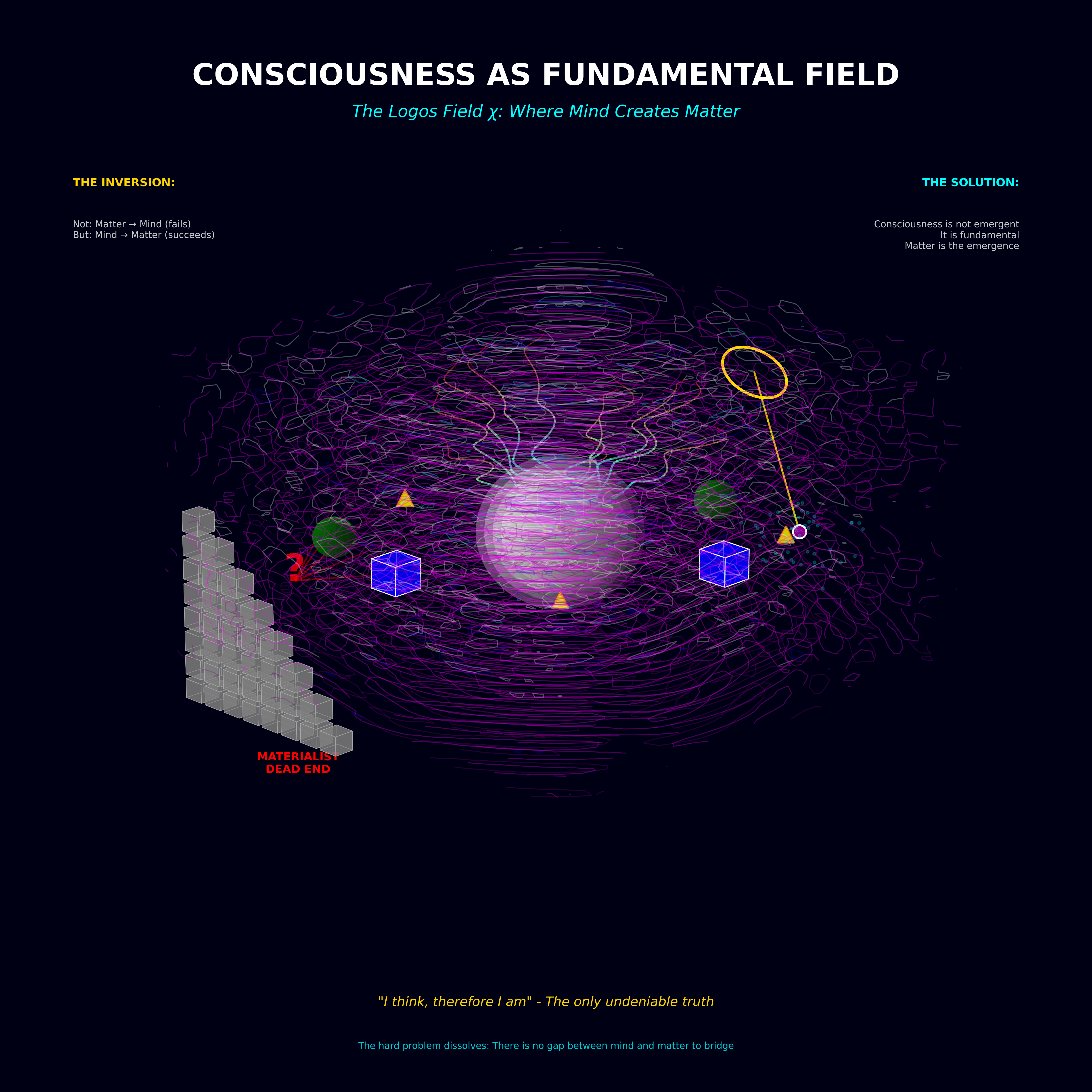
In this framework, consciousness is not an emergent property of complex matter. Consciousness is a *variable in the equation*. The C in the Master Equation. It is not produced by the system. It is a component of the system.
This is not a minor distinction. It is the difference between saying consciousness is what brains do (the materialist position) and saying consciousness is what the universe requires (the information-theoretic position). Wheeler's Participatory Anthropic Principle already demonstrated that observers are necessary for reality to become definite. The χ-field makes this formal: consciousness is a term in the coherence integral, and removing it collapses the entire framework.
The hard problem dissolves — not because it is solved within materialism, but because it is revealed as a consequence of materialism's category error. If you assume that matter is fundamental and consciousness is derivative, you will never explain how matter produces consciousness, because matter doesn't produce consciousness. Information produces both. Consciousness and matter are two outputs of the same computational process, two projections of the same coherence field, two terms in the same equation.
The Observer Inside the Code
There is a discomfort that physicists feel when consciousness enters the conversation. It smells like mysticism. It sounds like someone trying to smuggle God into the equations through the back door.
But the discomfort is misplaced. Consciousness is already in the equations. It has been there since 1927, when the Copenhagen interpretation placed the observer at the center of quantum mechanics. It has been there since Wheeler's "It from Bit," which made measurement — an act that requires a conscious agent — the fundamental engine of reality. It has been there since the PEAR Lab at Princeton produced 6.35σ evidence across 2.5 million trials that conscious intention affects the output of random event generators.
The evidence is not ambiguous. The experimental results are not marginal. The hard problem is not a philosophical curiosity. They are all pointing in the same direction: consciousness is not a byproduct of physics. It is a constituent of physics. It is not the audience watching the code execute. It is a variable inside the code.
And if consciousness is inside the code — if the observer is part of the system, not separate from it — then the question changes. The question is no longer how does the brain produce consciousness. The question is: what is the relationship between the code and the observer? Between the language and the speaker? Between the Logos and the mind that runs inside it?
The answer, when it comes, will not arrive through neuroscience alone. It will arrive through the convergence of information theory, quantum mechanics, and the oldest question humanity has ever asked: who are we, and why are we aware?
The code runs. The observer observes. And somewhere in the relationship between the two — in the irreducible first-person reality of being conscious inside a universe made of information — is the fingerprint of the Coder who made both.
> [!abstract]- Canonical Navigation
> - Previous: [[Chapter 6 The Resolution]]
> - Next: [[Chapter 8 The Binary Soul]]
> - Series: [[Logos Story Index]]