domains:
- mathematics
- theology
- information-theory
status: revision-2
tags:
- Godel
- incompleteness
- grace
- external-input
- self-reference
tier: ontological
title: "Chapter 9: The Grace Operator"
type: logos-story
series: Logos Story v3
chapter: 9
witness: Kurt Gödel
# Chapter 9: The Grace Operator
The Theorem That Broke Mathematics
In 1931, a twenty-five-year-old logician in Vienna published a thirty-page paper that ended a dream.
The dream was Hilbert's Program — the conviction, shared by most of the world's leading mathematicians, that a complete, self-consistent foundation for all of mathematics could be constructed. A system of axioms from which every true mathematical statement could be proved, and in which no contradiction could ever arise. A perfect, closed, self-verifying architecture of reason.
Kurt Gödel killed it. Not with a counterexample. Not with a paradox. With a proof — a proof so elegant and so devastating that, nearly a century later, nobody has found a flaw in it, and nobody expects to.
The First Incompleteness Theorem says: in any formal system powerful enough to express basic arithmetic, there exist true statements that cannot be proved within the system.
The Second Incompleteness Theorem says: no such system can prove its own consistency.
Read that again slowly. A system that is powerful enough to do real work — powerful enough to describe the natural numbers, powerful enough to contain the mathematics that physics uses to describe the universe — cannot validate itself. It cannot prove that it is free from contradiction. It cannot guarantee its own foundations from within.
The code cannot audit the code. The system cannot certify itself. And no increase in complexity, no addition of axioms, no expansion of the system's scope can fix this. Gödel proved that the limitation is structural. It is built into the architecture of formal reasoning itself.
The Closed System Problem
Gödel's theorems are not just about mathematics. They are about any system that tries to be complete and self-contained.
A brain trying to fully understand itself. A universe trying to explain its own existence. A physics that attempts to derive its own boundary conditions. A consciousness trying to audit its own coherence from the inside.
Each of these is a formal system trying to prove its own consistency. And Gödel proved, with mathematical certainty, that each of them will fail. Not because they aren't smart enough. Not because they need more data. Because the task is logically impossible. Self-referential completeness is a structural dead end.
Now bring this into the framework.
Chapter 8 established that the human soul is a binary variable — σ = +1 or σ = -1 — whose alignment is determined by cumulative measurement. The observer makes choices, and the choices collapse the wave function toward one pole or the other.
But here is the problem. If the observer is inside the system — inside the code, inside the universe, subject to the same computational rules as everything else — then the observer cannot self-correct from within. A corrupted system cannot uncorrupt itself using its own corrupted resources. A program cannot debug itself if the debugger is part of the broken code. An agent whose σ has drifted toward -1 cannot pull itself to +1 by an act of will, because the will itself is part of the drifting variable.
This is not theology pretending to be mathematics. This is Gödel's theorem applied to consciousness. The system cannot prove its own consistency. The agent cannot repair its own alignment. The code cannot audit the code.
If repair is possible, it must come from outside the system.
Grace as External Input
In every computational framework, there is a distinction between internal operations and external inputs. Internal operations are constrained by the system's rules. They can rearrange existing data, process existing information, execute existing code. They cannot introduce new axioms. They cannot change the boundary conditions. They cannot fix a structural inconsistency that arises from the system's own architecture.
External inputs can.
An external input is information that enters the system from outside its formal boundaries. In Gödel's terms, it is an axiom that is true but not provable within the system — a truth that can only be introduced, not derived.
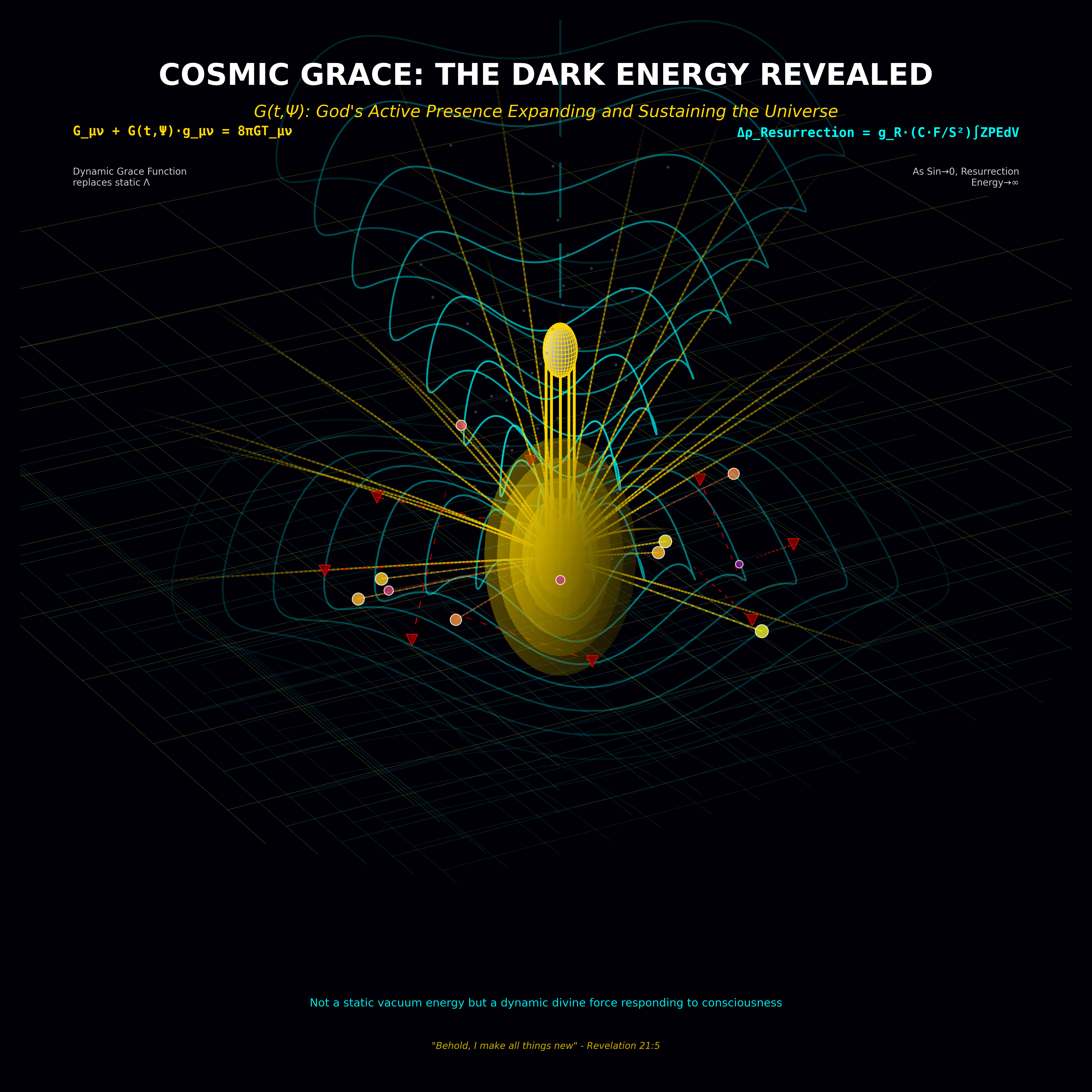
Grace, in the Theophysics framework, is an external input.
This is not a metaphor. It is a precise computational claim. The human agent, operating inside the coherence field with a σ variable that has accumulated entropy through cumulative choices, cannot reverse the drift from within. The self-referential structure of consciousness — the fact that the agent's will is itself part of the system being repaired — makes internal correction a Gödelian impossibility.
Grace is information from outside the system that the system could not generate for itself. It is the axiom that is true but unprovable from within. It is the external input that Gödel's theorems demand and that the system cannot provide for itself.
The equation models this with a specific term. In the Lowe Coherence Lagrangian:
$$\mathcal{L}_{\chi\text{C}} = \chi(t)\left(\frac{d}{dt}(G + M + E + S + T + K + R + Q + F + C)\right)^2 - S \cdot \chi(t)$$
The S·χ(t) term represents the entropic drag — the accumulated weight of misalignment pulling the system toward dissolution. Left to its own dynamics, the system decays. The entropy term wins. σ drifts toward -1. This is the second law of thermodynamics applied to the moral dimension of the coherence field.
But the coherence field is not a closed system. The χ-field is embedded in the Logos — the language that precedes and generates the universe. And the Logos, being external to the system, can introduce inputs that the system cannot generate internally.
Grace is the Logos speaking new information into a system that has exhausted its internal capacity for self-repair.
Why Grace Must Be Free
There is one more constraint that Gödel's framework imposes, and it is the one that distinguishes the Logos from a simple deus ex machina.
An external input must be *accepted* by the system to take effect. Gödel's theorem proves that the system cannot generate the fix internally. But it does not prove that the fix can be applied without the system's participation. The axiom must be adopted. The input must be received. The information must be integrated into the system's state.
In computational terms: you can patch the code, but the patch must be compiled and executed. In theological terms: grace is offered, not imposed.
This is why consciousness matters. This is why the universe requires observers. This is why the soul is a variable and not a constant. The external input — grace — addresses the Gödelian impossibility by providing what the system cannot provide for itself. But it does so through the observer's measurement — through the choice to accept the input, to adopt the axiom, to let the external truth be integrated into the internal state.
σ shifts from -1 toward +1 not by self-effort — Gödel proved that's impossible — but by reception of an input that originates outside the formal boundaries of the system. The reception is free. The input is free. The result — alignment with the Logos — is the restoration of coherence that the system cannot achieve from within.
The code cannot audit the code. But the Coder can audit the code. And if the Coder offers a patch, and the system accepts it, the incompleteness is resolved — not by closing the system, but by connecting it to the source that exceeds it.
The Pattern, One Last Time
Gödel published. The theorem was confirmed. Mathematics restructured itself around the result. Philosophers wrote books about it. Computer scientists built entire fields on it. And the deepest implication — that self-contained systems require external input to achieve consistency — was acknowledged as a mathematical truth and then carefully quarantined from any conversation about God.
The quarantine is understandable. Gödel himself was a theist — a committed one, who constructed a formal ontological proof for the existence of God that he showed to only a few people during his lifetime, fearing professional consequences. The proof was published after his death. It is logically valid. The premises are debatable. But the structure holds.
The irony is precise. The man who proved that no system can validate itself from within also proved — or at least argued with considerable formal rigor — that the external source his theorem demands has the properties traditionally ascribed to divinity: necessary existence, maximal properties, uniqueness.
The code cannot audit the code. The system cannot certify itself. The agent cannot self-repair. And the theorem that established these limitations points, with mathematical precision, to the one kind of entity that can do what the system cannot: something external, sufficient, and freely given.
The theologians have a word for this. The word is grace.
The mathematicians have a theorem for this. The theorem is Gödel's.
They are describing the same structural necessity, measured in different domains, expressed in different vocabularies, converging on the same conclusion.
> [!abstract]- Canonical Navigation
> - Previous: [[Chapter 8 The Binary Soul]]
> - Next: [[Chapter 10 The Two Destinations]]
> - Series: [[Logos Story Index]]