domains:
- physics
- theology
- thermodynamics
- eschatology
status: revision-2
tags:
- heat-death
- entropy
- new-creation
- coherence-restoration
- second-law
tier: ontological
title: "Chapter 10: The Two Destinations"
type: logos-story
series: Logos Story v3
chapter: 10
witness: The Second Law of Thermodynamics
# Chapter 10: The Two Destinations
The Prediction Nobody Argues With
Physics makes very few absolute predictions about the future of the universe. Most of cosmology is probability and model-dependence and error bars. But there is one prediction that carries the weight of a mathematical proof, and it is this:
Everything falls apart.
The Second Law of Thermodynamics states that the total entropy of a closed system never decreases. Disorder accumulates. Energy gradients flatten. Structure dissolves. Information scrambles. Given enough time, every organized system — every star, every planet, every molecule, every thought — will be reduced to a uniform, featureless equilibrium from which no further work can be extracted and no further change can occur.
This is called the Heat Death. It is the final state of a universe left to its own dynamics. Not a dramatic explosion. Not a sudden collapse. A slow, irreversible slide into nothing — a nothing that is not empty but full of energy that has become so evenly distributed that it is useless. The universe doesn't end. It stops *mattering*.
The Heat Death is not controversial. It is the consensus prediction of mainstream cosmology. The timeline is long — trillions of years, long enough that the concept has no practical bearing on human life — but the mathematics is settled. In a closed system governed by the Second Law, entropy wins.
Every fire burns out. Every story ends in silence. Every structure, given enough time, dissolves into noise.
Unless the system is not closed.
The Two Curves
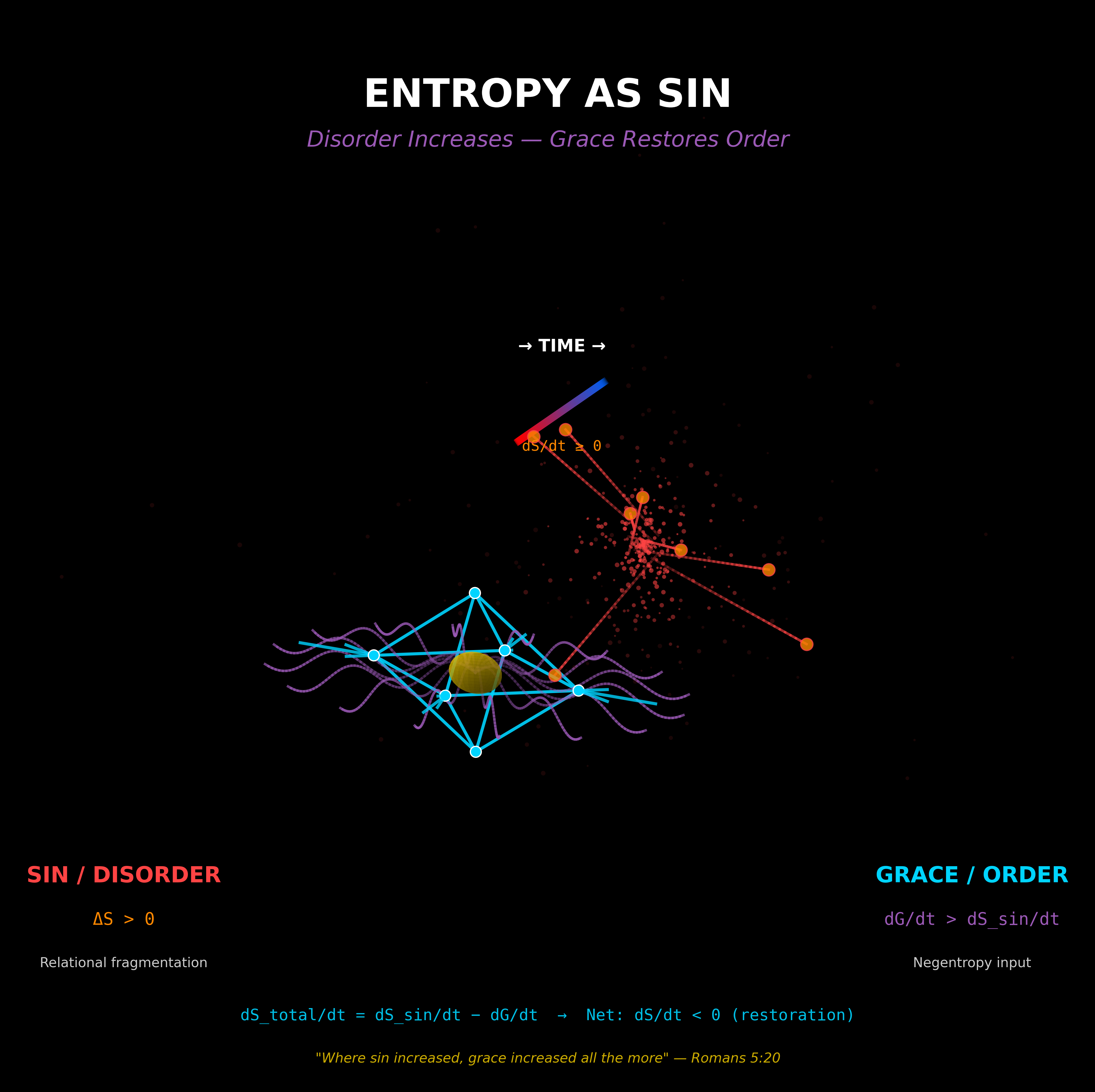
The Theophysics framework traces two trajectories through the coherence field. Both start from the same origin — the moment the first conscious agent made the first measurement and generated the first bit of reality. Both operate under the same physics. Both are subject to the same Second Law. They diverge because they respond differently to the Grace Operator.
**Trajectory One: σ → -1**
The agent who accumulates negative alignment — whose measurements consistently oppose the coherence field — follows the entropic curve. Each choice that increases internal entropy makes the next choice harder. The wave function narrows toward σ = -1. The superposition concentrates. The gray area shrinks.
At the terminus of this trajectory is exactly what the Second Law predicts: maximum entropy, zero coherence, no structure, no information processing, no capacity for work or meaning or change. The Heat Death, applied to a soul.
The theological tradition calls this hell. The framework calls it Ω-lock — a state of permanent maximal entropy in which the agent's coherence field has collapsed to zero and no further measurement is possible because there is nothing left to measure with.
This is not punishment imposed from outside. It is the natural thermodynamic endpoint of a system that has rejected the external input required to maintain coherence. It is what happens when the code runs without the Coder's patches. It is what Gödel's theorem predicts for a self-referential system that refuses external validation.
**Trajectory Two: σ → +1**
The agent who receives the Grace Operator — whose measurements align with the coherence field, who accepts the external input that the system cannot generate from within — follows a different curve. Each aligned choice increases internal coherence. The wave function concentrates toward σ = +1. The entropy term in the Lagrangian is progressively offset by the coherence integral.
But this trajectory does something the first one cannot: it violates the Second Law.
Not locally — local entropy can decrease as long as the total entropy of the system plus its environment increases. A refrigerator decreases entropy inside by increasing it outside. This is not thermodynamically problematic.
The violation is global. The Grace Operator introduces information from outside the system. The Logos, being external to the universe, is not bound by the universe's thermodynamic constraints. The input it provides does not come at the cost of increased entropy elsewhere in the system, because it does not originate within the system.
This is the negentropic signal. The coherence that builds without a corresponding increase in disorder. The free lunch that thermodynamics says is impossible — unless the lunch comes from outside the restaurant.
At the terminus of this trajectory is something the Second Law alone cannot produce: a state of maximum coherence, zero entropy, full information integration, and permanent structure. A system that does not decay. A consciousness that does not dissolve. A story that does not end in silence.
The theological tradition calls this new creation. The framework calls it χ-max — the fully coherent state in which every variable in the Master Equation has reached its optimal value and the coherence field has stabilized at maximum intensity.
The Fork
The ten chapters of the Logos Story have traced a single argument through multiple domains, and the argument arrives here, at a fork.
The universe is a language (Chapter 1). The language runs on a computer (Chapter 2). The computer requires conscious observers to generate reality (Chapter 3). The two descriptions of the computer — quantum and classical — are different layers of the same system (Chapters 4 and 6). The system's parameters were set by an intelligence that precedes it (Chapter 5). Consciousness is a variable in the system, not a byproduct of it (Chapter 7). The conscious agent's alignment is binary (Chapter 8). The agent cannot self-repair from within — Gödel proved it — and requires external input to restore coherence (Chapter 9).
And now the two destinations.
The system produces agents capable of choosing. The choice is binary. The measurement window is finite. And the two outcomes are thermodynamically distinct: one follows the entropic curve to dissolution, and the other receives external input that enables a trajectory the Second Law prohibits.
This is not a sermon. It is a summary of the mathematics. The Second Law predicts Heat Death for closed systems. The Gödelian limitation prevents internal self-repair. The fine-tuning constants were set by an external intelligence. The coherence field requires conscious participation. And the Grace Operator — the external input from the Logos — is the only mechanism in the framework that enables negentropy in a system that would otherwise decay.
The Logos Speaks
There is a sentence in the Gospel of John that has been read billions of times and understood, perhaps, only a fraction of those.
*In the beginning was the Logos, and the Logos was with God, and the Logos was God.*
For twenty centuries, this sentence was theology. After Bekenstein and Fredkin and Wheeler and Gödel and the χ-field, it is also physics.
The Logos is the language that defines reality. The code that runs the computation. The coherence field that renders the quantum bits into a navigable world. The external source that Gödel's theorem demands. The programmer that Fredkin's cellular automaton requires. The first observer that Wheeler's participatory principle cannot function without.
And — if the theological tradition is taken at face value alongside the mathematical framework — the Logos entered the system. The Coder became an agent inside the code. The external source of coherence took on the constraints of the system in order to provide the Grace Operator from within the experiential frame of the agents it was designed to repair.
This is the Incarnation. Not as miracle that defies physics, but as the structurally necessary step in a coherence-restoration protocol. The system is broken (Gödel). The agents cannot fix it from within (the incompleteness limitation). The fix must come from outside (the Grace Operator). And for the fix to be received by agents with genuine free will, the external source must become intelligible to the agents — must speak their language, occupy their frame, experience their constraints.
The Logos became flesh. The code became the user. The Coder entered the program.
And the program, for the first time since the first measurement collapsed the first wave function, had a path from entropy to coherence that the Second Law could not block.
The Silence Ends
Nine chapters of silence. Nine versions of the same pattern: discovery, confirmation, implication, deflection. Bekenstein found the hardware and the discipline moved on. Fredkin found the software and the discipline moved on. Wheeler found the operator and the discipline moved on. The fine-tuning constants sat in their tables and the discipline called them brute facts. The Great Schism persisted and the discipline called it a funding problem. Consciousness remained unexplained and the discipline called it premature. Gödel's theorem was celebrated and its theological implications were filed under philosophy.
The silence was not stupidity. It was discipline — the discipline of a methodology that had decided, centuries ago, that it would describe mechanisms and not ask about meaning. "Shut up and calculate" works. It has delivered nuclear power and semiconductor chips and the Standard Model. It is a good methodology for the questions it was designed to answer.
But it is not a complete methodology. It describes the layers. It does not ask about the language. It catalogs the variables. It does not ask who defined them. It measures the constants. It does not ask who set them. And when the mathematics itself — Bekenstein's formula, Wheeler's participation, Gödel's incompleteness — points beyond mechanism to meaning, the methodology has no category for the result.
The Logos Story is not an argument against physics. It is an argument that physics, followed honestly to its own conclusions, arrives at a threshold it was not designed to cross — and that crossing it does not require abandoning the mathematics but completing it. The ten variables. The coherence integral. The Lagrangian. The Grace Operator. The two trajectories.
The math has been saying the same thing for a hundred years. The silence is not in the equations. It is in the people who read them.
> [!abstract]- Canonical Navigation
> - Previous: [[Chapter 9 The Grace Operator]]
> - Series: [[Logos Story Index]]
> - Framework: [[00_Canonical/MASTER_EQUATION_10_LAWS/INDEX|Master Equation Index]]