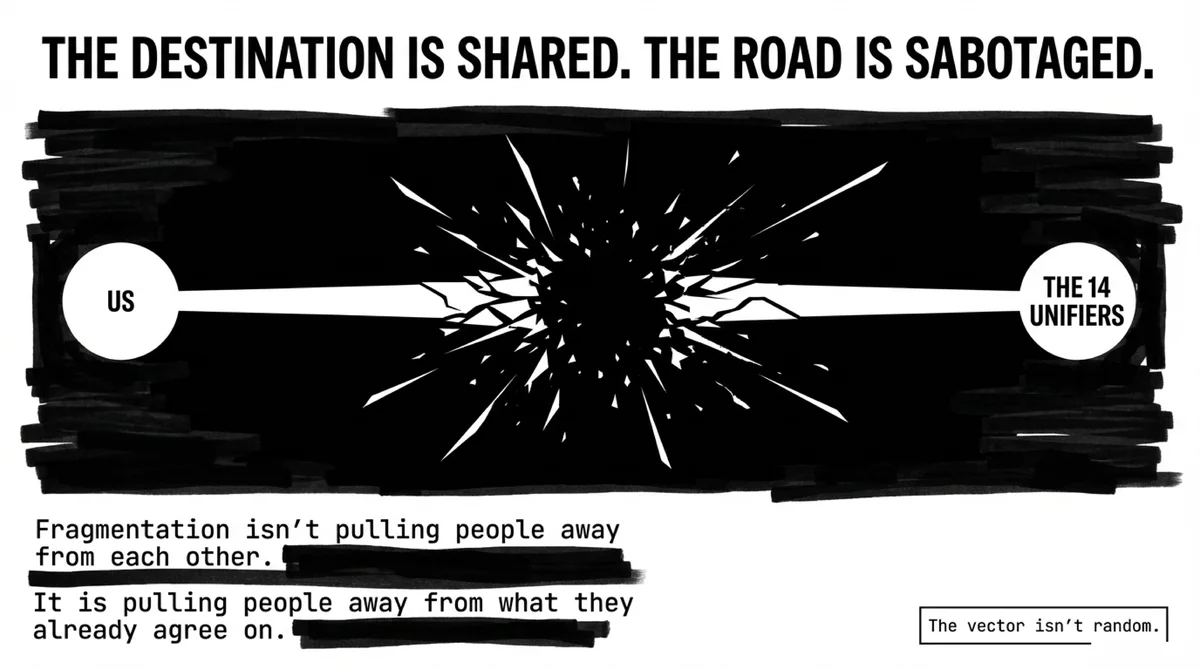
Can the universe be made out of a lie?
I don't think so. And once you see why, you can't un-see it.
Start with what evil actually does. Name any evil — murder, theft, betrayal, cruelty, lies. Every single one is parasitic. It takes something that already exists and breaks it. Murder takes life. Theft takes property. Lying takes truth. Adultery takes trust. Corruption takes institutions.
Evil has no vocabulary of its own. It borrows every word from good and inverts it.
Try it. Try to name an evil without referencing the good it violates. You can't. The word doesn't exist.
That means good comes first. Structurally. Not as an opinion — as a logical requirement. You cannot corrupt what isn't there.
Now flip it. If the devil was first — if a lying, destroying force was the ground of reality — what would he have created?
There would be nothing to take. Nothing to break. Nothing to invert. A liar with no truth to twist builds nothing. A destroyer with nothing to destroy is idle. Evil-first is self-defeating. It can't even get started.
So the ground of reality can't be a lie. And it can't be cruelty either. Because if cruelty were the foundation, the universe wouldn't hold together long enough for anyone to notice.
Instead, we got this one. A universe where math describes matter with impossible precision. Where galaxies hold their shape across billions of light-years. Where a mother's body releases chemicals that bond her to her child. Where two people can love each other with nothing to gain. Where sunsets happen. Where music happens.
That is not what a cruel foundation produces. That is what truth produces when it takes shape.
Let me tighten this with some precision.
The theologians had a word for this argument fifteen centuries before I got to it. Privatio boni. Evil as the privation of good. Augustine landed on it after years of wrestling with the problem: if God is the source of all being and God is perfectly good, then evil cannot be a created thing. Evil is the name we give to the absence of the good that should be there.
Not just any absence. A stone doesn't see — that's not evil, because sight isn't something a stone is supposed to have. But a human eye that goes blind — that's evil, because sight is a due good for an eye. Evil is a specific kind of absence. A hole in something that's supposed to be whole.
Thomas Aquinas sharpened it further. A trembling hand draws a crooked line. The hand is real. The act of drawing is real. The tremble — the defect — is what makes the line crooked. But the tremble doesn't exist on its own. It's a failure of the hand's proper function. Evil is always the failure of something that was supposed to work. It has no independent substance.
That's not just theology. That's a structural claim with teeth.
Here's where information theory enters.
Claude Shannon — the father of information theory — formalized something in 1948 that maps directly onto this argument. In any communication channel, you have signal and noise. Signal is the information you're trying to transmit. Noise is the random distortion that degrades it. Shannon proved that the capacity of a channel depends on the ratio of signal to noise — and that as noise increases, the channel's ability to carry information collapses toward zero.
Now apply that to reality itself.
If the ground of reality were deceptive — if the foundation were a lie — that would be maximal noise at the deepest level. Every signal built on top of it would be corrupted from the start. You couldn't have stable physical laws, because the substrate generating them would be unreliable. You couldn't have mathematics that describes matter with precision, because the correspondence between abstract logic and physical structure would be contaminated at the source. You couldn't do science at all, because science depends on the repeatability of natural law — and a lying foundation doesn't repeat. It contradicts.
In information-theoretic terms, a deceptive ground state maximizes entropy — disorder — at the foundational level. And a system at maximum entropy doesn't produce structure. It produces noise. Static. Nothing you can build on.
But our universe is the opposite of that. It's astonishingly low-entropy. The laws hold. The math works. The constants are stable to more decimal places than we can measure. The physical universe is the single strongest piece of evidence that the ground state is truthful — because if it weren't, nothing we observe would be possible.
There's a problem in computer science that makes this even more concrete.
It's called the Byzantine Generals Problem. Imagine a group of generals surrounding a city. They need to coordinate an attack — but some of the generals are traitors who will send false messages. The question is: can the loyal generals still reach consensus?
The answer, proven mathematically, is that you need at least two-thirds of the generals to be honest. If more than a third are liars, consensus becomes impossible. The system collapses. No coordinated action can occur.
Now think of the physical constants as messages. Gravity, electromagnetism, the strong force, the weak force — all of them have to coordinate to produce a universe that holds together. Atoms need to form. Stars need to burn. Chemistry needs to work. Biology needs to emerge from chemistry. Every one of these is a coordination problem. And the coordination works — with a precision that's beyond absurd.
If the ground of reality were a traitor — a deceptive substrate sending false signals — the coordination would fail. The generals would never agree. The universe would never cohere. You'd get noise, not galaxies.
We got galaxies.
The Byzantine Generals Problem tells you that the ground is honest. Not metaphorically honest. Mathematically honest. The coordination we observe is proof that the signal at the bottom is clean.
A philosopher named Stephen Law proposed what he called the "Evil-God Challenge." His argument: everything you can say about why a good God would create this world can be mirrored by a symmetric argument about an evil God. If the theist explains evil as "permitted for a greater good," the maltheist explains good as "permitted for a greater evil." It's a clever move. And it's wrong.
Here's why the symmetry breaks.
A good God creates out of fullness. The act of creation is self-giving — producing something other than yourself for the benefit of the other. A good God doesn't need the creation. The creation is a gift.
An evil God creates to maximize suffering. But that means the evil God needs the creation. Without creatures to torment, the evil God has no purpose. An evil God that creates is dependent on its creation — which makes it incomplete. And an incomplete being isn't a ground of reality. It's a derivative.
Deeper: for a being to be evil, there has to be a standard of good it's violating. Evil is the failure to meet a standard — privatio boni. So the standard has to come first. The good is more fundamental than the evil, even in the definition of what evil is. An "evil God" is subordinate to the good it's betraying.
And deepest: the "Problem of Good" is harder for the maltheist than the Problem of Evil is for the theist. The theist has to explain why a good God permits suffering — and that's hard. We'll score it honestly in the next chapter. But the maltheist has to explain why an evil God permits oxytocin. Why an evil God permits the capacity for self-sacrifice. Why an evil God designed a universe where a stranger dives into a frozen river to save a child he's never met. Why an evil God made music. Why an evil God permitted E=mc². Why sunsets.
Evil produces Auschwitz. It does not produce the ability to appreciate a Bach cantata. It does not produce a mother's body bonding to her child through chemistry she didn't choose. It does not produce two people loving each other with nothing to gain.
The symmetry doesn't hold. And once it breaks, it breaks completely.
Here's what truth looks like at the foundation.
It's consistent — it doesn't contradict itself. It's eternal — it held before us and will hold after. It's unchanging — the math that worked a billion years ago still works. It's universal — same everywhere, no exceptions. It's ordered — it produces structure, not noise. It's generative — simple starting points produce infinite depth. It's beautiful — and anyone who's ever seen an equation like E=mc² knows beauty when they see it.
Truth has a signature. You can read it off the world.
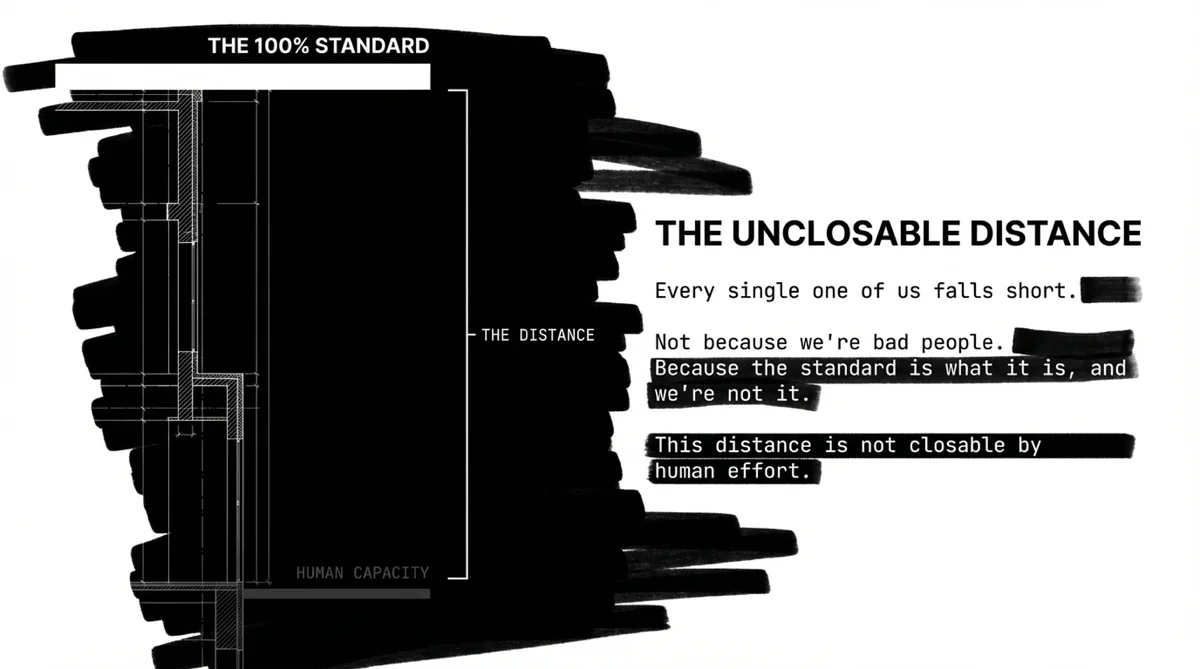
A world made from a lie would have none of those properties. Ours has all of them.
That's why I believe what I believe. Not because I stopped asking hard questions — because I kept asking them, and the answers kept pointing the same direction.
The universe was made from truth. And because truth and love are the same thing at the bottom — because a truthful ground that creates freely and gives generously is what love looks like when it takes structural form — love is what's underneath all of it.
The world isn't a lie. It couldn't be. And neither are we.
Seven words: Evil can't be first. Only good creates reality.
One chapter left. The scorecard. The honest weakness. The kill conditions. Everything we've built, scored in the open.